More often than not, when we travel, we are drawn to the sensational. Back home, we tend to remember only those moments when adrenaline did its work—when intensity convinced us we had lived something “extraordinary.” Yet there are travelers who move differently through the world: quietly attentive, their gaze softened, following each detail of an itinerary as though it were a fragile, deliberate gift.
Nature offers the stage for all our departures—vast skies that hold both dawn and dusk in their theatrical brilliance, the arid geometry of desert lands, the damp opacity of tropical forests, and the sea, infinite in its blue variations, from turquoise clarity to the depth of dark indigo. It is into this immensity that we step when we travel. And it is here that the soul, too, finds its brief cooling—submerged in a moving blue that can shift from calm to fury in a matter of hours.
Every true journey asks for a certain opening of perception: a willingness to receive invisible signals, subtle messages, and quiet lessons offered by nature and by others without announcement or spectacle.
Nearly a decade ago, I found myself on a short sea voyage aboard a modest vessel carrying about fifty passengers. For most, it was a brief escape—an opportunity to see the sea, perhaps to photograph a few gulls arranged, conveniently, as if for social media mythology. For me, it became something else entirely: a lesson in attention, and in how much is lost when we fail to notice what is offered without demand.
We are here. Do not be afraid.
As we left the harbor, the sea greeted us gently. The sky was a clean azure, mirroring the water below, as though two infinite planes were negotiating a meeting point they could never quite reach. The atmosphere was easy. People spoke, photographed, or simply stared outward, letting the horizon do the work of imagination.
But soon, the weather began to shift. The sky deepened into a muted grey-blue, and the wind rose with sudden authority, as if summoned by some ancient will. The sea responded. Waves grew heavier, more deliberate, as though the elements were no longer content with their earlier calm. The silence on board dissolved into nervous fragments. Passengers withdrew into cabins, unsettled by the rising force of the water. Yet the vessel itself remained steady, guided by a captain who seemed to read the sea as one reads a familiar language.
It was not anger I sensed in this transformation, but invitation. As though the sea—mythically vast, almost conscious—were asking us to go further into its nature, to see beyond the surface performance of storm and motion.
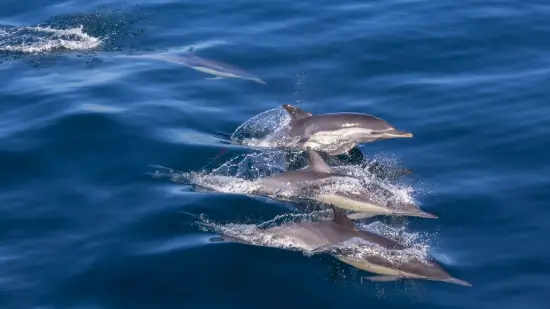
I accepted Poseidon’s invitation to look beyond the raging waves, noticing what others seemed to ignore in the storm unfolding around us. On both sides of the ship, a group of dolphins accompanied us with quiet grace—not performing acrobatics, not seeking attention, simply swimming in silence alongside our vessel. I could not hear them, the storm had swallowed all sound, yet they appeared to be watching over us.”
I followed them for a long time through the porthole, as they moved swiftly through the water beside us. And in those moments of uncertainty, I came to understand that they were conveying something wordless, almost enigmatic: “We are here. Do not be afraid.”
Few passengers noticed them. Most were preoccupied with the drama of the storm, captivated by the visible force of nature unfolding in front of them. And yet, in that selective attention, something essential was missed—the quieter choreography unfolding just beneath the spectacle. Our perception is often narrowed by fear, by exaggeration, by the need to convert experience into something immediately impressive. But not everything meaningful announces itself loudly. The magnitude of the waves is not the essence of the journey. Neither is the storm. The essence may lie, instead, in the quiet continuity of life moving alongside us, unasked for, unadvertised.
Hours later, as the storm began to dissolve back into calm, a different kind of stillness settled over everything. It felt less like silence and more like restoration. The dolphins remained with me in thought—no longer just animals in passing, but symbols of a different kind of attention: one that does not seek to dominate experience, only to witness it.
Travel, like life itself, tends to seduce us with spectacle. We remember what is loud, what is dramatic, what confirms that something “happened.” And yet the deeper textures of experience often reside elsewhere—in gestures almost imperceptible, in presences that do not insist on being seen.
The Art of Travel, then, is not merely movement through space. It is the discipline of seeing what does not compete for our gaze. It is the practice of noticing what does not perform for us.
The dolphins in the storm became, for me, a quiet metaphor for this: a reminder that connection is often subtle, that protection is rarely theatrical, and that meaning is frequently hidden in plain sight.
In the end, every journey requires this opening of perception—this willingness to receive what does not announce itself. Nature, in all its vastness, continues to offer such lessons without insisting they be understood.
What we fail to see, because we are looking elsewhere, may well be the most important part of the journey.