At the edge of the world, where the Pacific seems to swallow time itself and isolate the land from the rest of the planet, lies New Zealand — two islands adrift in the immensity of the ocean, carrying their solitude almost as a destiny. Seen from afar, the country appears like an improbable promise: a realm of purity, untouched nature, and Edenic stillness, transformed by travel brochures into an almost mythical paradise.
Now, the ancient tribal world of the Māori has changed profoundly. The lands of old have become vast farms of sheep, cattle, and deer, and the pastoral landscape now defines these islands. Yes, here deer are raised in captivity, their meat destined for the lavish tables of the world. Everywhere one encounters green — the green of endless grasslands, of gentle hills, but also the green of a political culture deeply preoccupied with the protection of nature.
New Zealanders guard the biological balance of their country with an almost ritual severity. At the border, even a moment of carelessness may lead to serious fines if there is the slightest suspicion that one might introduce bacteria, seeds, or viruses capable of disturbing the fragile ecosystem of the islands. The lessons of the past have made them profoundly cautious. Decades ago, human attempts to eradicate certain rodents triggered dramatic imbalances and the disappearance of other species. From that moment on, New Zealanders understood that nature never forgives human arrogance.
New Zealand — two islands adrift in the immensity of the ocean, carrying their solitude almost as a destiny.
Many now speak nostalgically of the years before 2000, when the population was smaller and the country seemed more orderly, safer, and closer to its original spirit. Amid all these transformations, the Māori remain perhaps the most authentic presence in New Zealand. They carry their traditions with a calm, almost sacred dignity, as though the memory of their ancestors still watches over the islands.
And the kiwi bird — the national symbol of this distant world — has itself become a protected creature, hidden away in reserves and specially guarded habitats, sheltered from the threats of modernity. It appears like a living relic from a vanished age, a fragile shadow of a world that civilization is slowly pushing toward oblivion.
Auckland is a pleasant and cosmopolitan city, stretched between two bays, with elegant harbours, modern districts, and numerous cultural landmarks that give it the air of a tranquil metropolis at the far end of the earth. The Sky Tower dominates the skyline, while museums, galleries, and old colonial buildings preserve something of the blend of European spirit and Polynesian tradition that defines New Zealand. On clear evenings, the harbour lights and the silhouettes of yachts create the impression of a city suspended between ocean and sky.
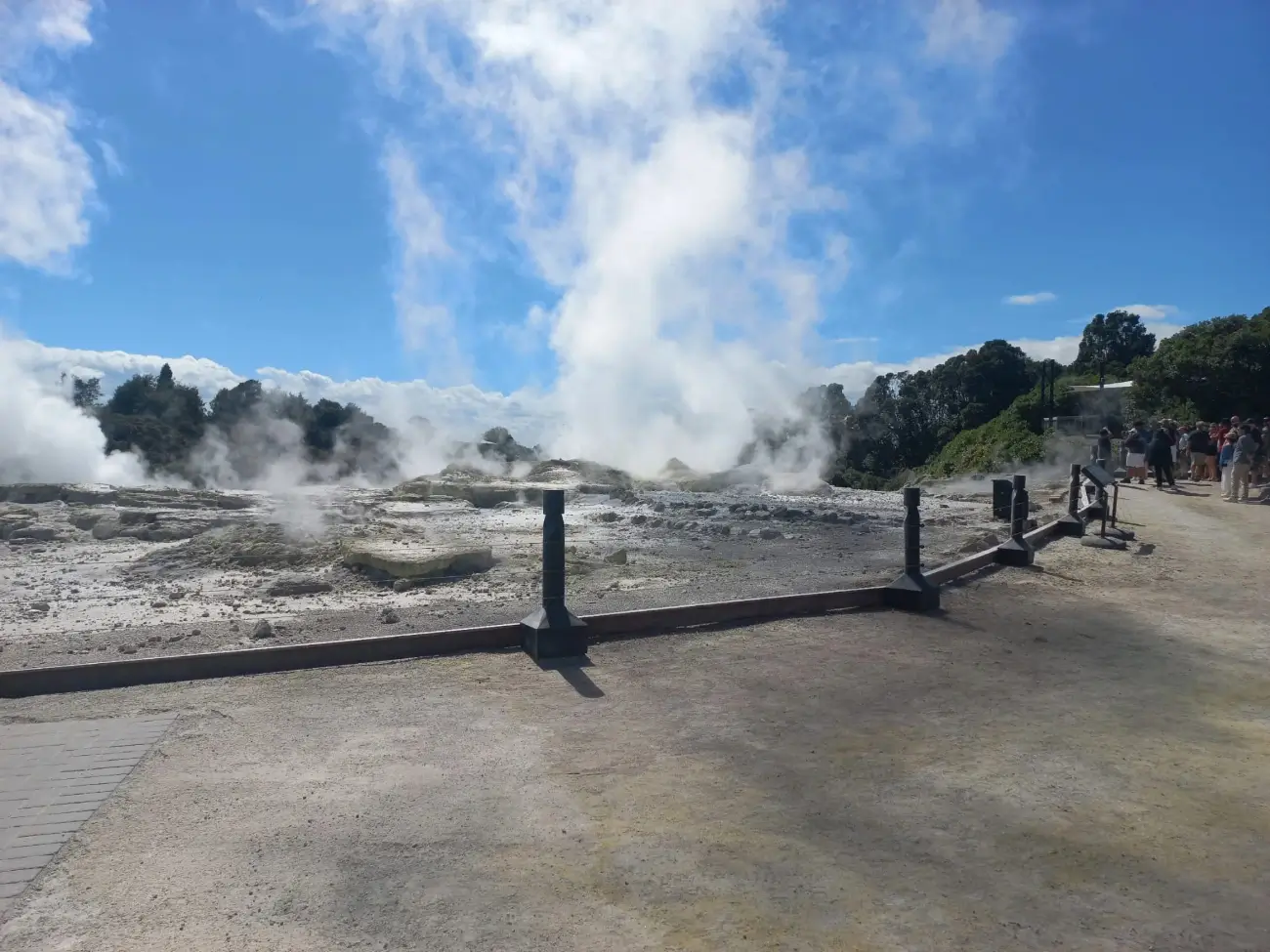
Rotorua reveals another face of the country — primordial, almost telluric. Here the earth breathes through geysers, hot springs, and bubbling mud craters, while the heavy scent of sulfur drifts constantly over the town, like a reminder of the hidden forces beneath the surface. Around the volcanic lakes and dense forests, Māori culture still makes its presence felt through ritual dances, carvings, and ancient legends of the earth’s fire.
Aoraki / Mount Cook rises solemnly above the glaciers like a vast cathedral of stone and ice, dominating the landscape with an almost intimidating grandeur. In the cold light of morning, its ridges seem unreal, while the silence surrounding the mountain carries something sacred within it, as though time itself were slowing among the eternal snows.
Farther south, Milford Sound opens its silent fjords like gateways into a primordial world. Steep rock walls rise directly from the water, waterfalls descend from dizzying heights, and the mist that so often drifts across the fjords transforms everything into an almost mythological landscape. In the presence of such nature, one has the feeling of entering a time older than memory itself.
In the presence of such nature, one has the feeling of entering a time older than memory itself.