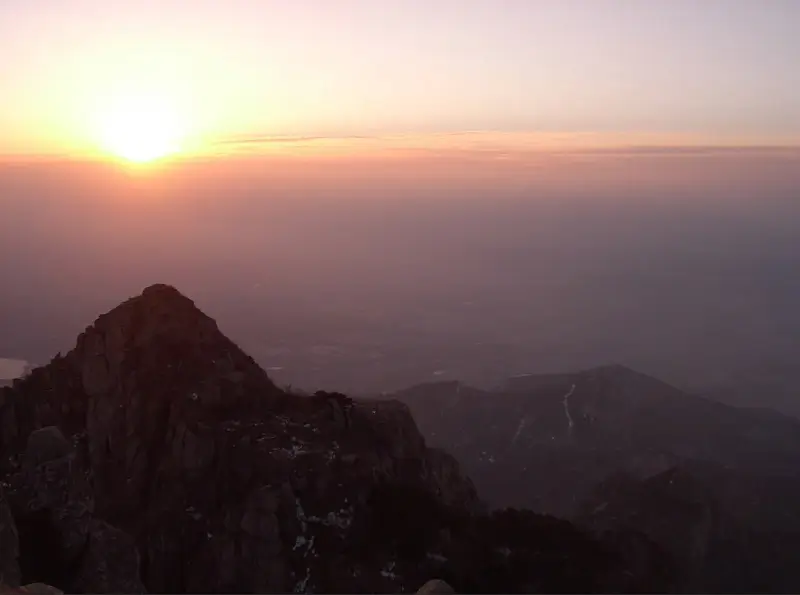
Rising from the plains of Shandong, Taishan appears almost modest against the immense horizon. Its summit reaches 1,545 metres above the surrounding land, a height that seems restrained beside the great ranges of Asia, while its place in Chinese civilization has grown immeasurably beyond its physical stature. For more than three thousand years, Taishan has been regarded as a sacred mountain, a place where Heaven, Earth and humanity could enter into a relationship expressed through ritual, pilgrimage, prayer and contemplation. As the Eastern Mountain of the Five Sacred Mountains, it became associated with the rising sun, spring and renewal, and with an ancient understanding of the world in which directions, seasons, natural forces and human life belonged to a greater order.
Taishan has been regarded as a sacred mountain, a place where Heaven, Earth and humanity could enter into a relationship expressed through ritual, pilgrimage, prayer and contemplation.
To approach Taishan is therefore to enter a landscape in which geography carries a deeper meaning. The mountain rises from the eastern plains where the sun begins its daily journey, and its sacred character grew from the belief that the visible world was woven into forces extending beyond what the eye could perceive. In this sense, Taishan offers a window into the way a civilization imagined Heaven, Earth, humanity and the order of the world, allowing philosophy to be encountered not only in texts, but in stone, ritual and place.
For nearly two thousand years, emperors travelled to Taishan to perform the ancient Feng and Shan ceremonies, among the most solemn rites of imperial China. The journey carried a significance far beyond the physical ascent, for the emperor, regarded as the Son of Heaven, came to the sacred mountain to honour Heaven and Earth and to acknowledge that earthly authority existed within a greater cosmic order. At the summit, Heaven was honoured; at a lower sacred site, offerings were made to Earth, and between these two realms stood the human being, entrusted with the responsibility of preserving harmony within the world.
The ceremonies gave physical expression to a profound idea that would later find its clearest philosophical formulation in Tian Ren He Yi, the unity of Heaven and humanity. On Taishan, this relationship could be experienced through movement and ritual: the emperor climbing beneath the open sky, the earth beneath his feet, the sacred mountain rising between the two, and the human world suspended within an order larger than itself. The mountain became a place where the political and the sacred met, where imperial authority was placed beneath Heaven and where the ruler's responsibility extended beyond the boundaries of his court.
The ceremonies gave physical expression to philosophical formulation Tian Ren He Yi, the unity of Heaven and humanity.
Over the centuries, the mountain gathered another form of presence through those who came to write upon it. Emperors, scholars, poets, religious figures and pilgrims left inscriptions across its slopes, while temples, gateways, ancient trees and works of art gradually became part of the sacred landscape. Around 1,800 stone tablets and inscriptions survive, carrying imperial proclamations, poems, religious texts and the names or reflections of those who wished their thoughts to remain upon the mountain. The words were carved into the same stone that generations of pilgrims climbed, allowing ideas to become part of the landscape itself.
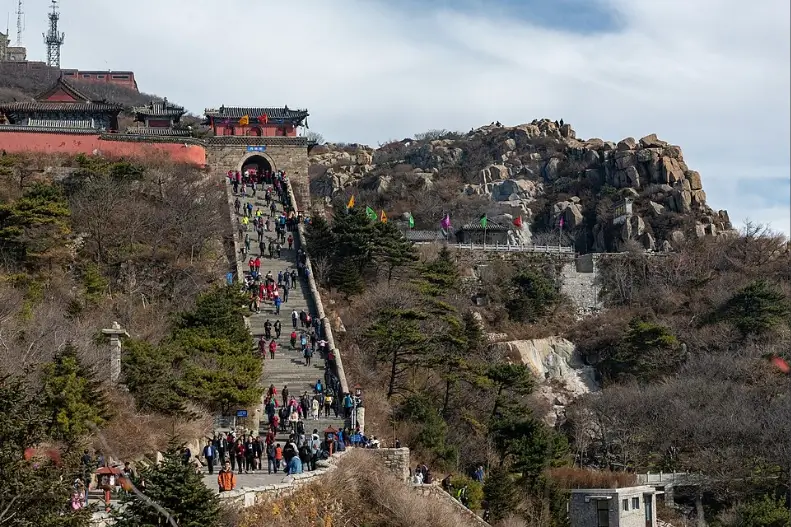
The mountain carries in its stone the remembrance of a civilization. What makes these inscriptions remarkable is not simply their age, but what people considered worthy of placing upon a sacred mountain: devotion, political authority, philosophical reflection, reverence for nature and the desire to honour Heaven. Taishan became a landscape of thought, where writing was no longer confined to paper or the pages of a book and where a civilization could leave something of its intellectual and spiritual life upon the face of the earth.
The words were carved into the same stone that generations of pilgrims climbed, allowing ideas to become part of the landscape itself.
At the foot of the mountain stands Dai Temple, the great ceremonial gateway through which emperors traditionally passed before beginning their ascent. Its halls, ancient trees, stone inscriptions and religious works of art form a threshold between the human world and the sacred mountain beyond. Among its treasures is the Hall of Heavenly Blessing, whose monumental Taoist mural, dating from 1009, depicts The God of Taishan Making a Journey. Across the wall unfolds a procession of figures, palaces, animals and bridges, each belonging to a larger order in which the divine and the human world remain closely connected. The painting offers a glimpse into a vision of the sacred where Heaven has its order, Earth possesses its forces and humanity lives within a universe whose parts are continually related.
The sacredness of Taishan also found its deepest expression beyond the ceremonies of emperors. High on the mountain, the Azure Cloud Temple became associated with Bixia Yuanjun, the Goddess of Mount Tai, whose worship grew during the Song dynasty and gradually became one of the most enduring forms of popular devotion connected with the mountain. She came to be revered especially by those who prayed for children, childbirth and health, and through her the great cosmological landscape of Taishan entered the intimate world of ordinary human hopes.
A mountain once approached by emperors in ceremonies concerning Heaven and the destiny of the realm could also receive the prayer of a parent carrying a private hope for a child. A pilgrim could climb toward the same summit seeking health, protection or a blessing for the family, bringing to the sacred landscape concerns that were deeply personal and entirely human. In these gestures, the vast structures of Chinese cosmology came close to everyday life, and the sacred mountain became a place where the universal and the intimate could exist within the same landscape.
The sacredness of Taishan also found its deepest expression beyond the ceremonies of emperors.
This continuity between the cosmic and the personal may help explain why Taishan has remained so deeply rooted in Chinese culture. Confucian ideas of order and responsibility, Taoist understandings of nature and the sacred, imperial ritual and popular religious practice all found expression upon its slopes, each contributing to the mountain's evolving significance while retaining its own character. Taishan became a place where different ways of approaching the world could meet, shaped by centuries of belief and practice rather than by a single doctrine.
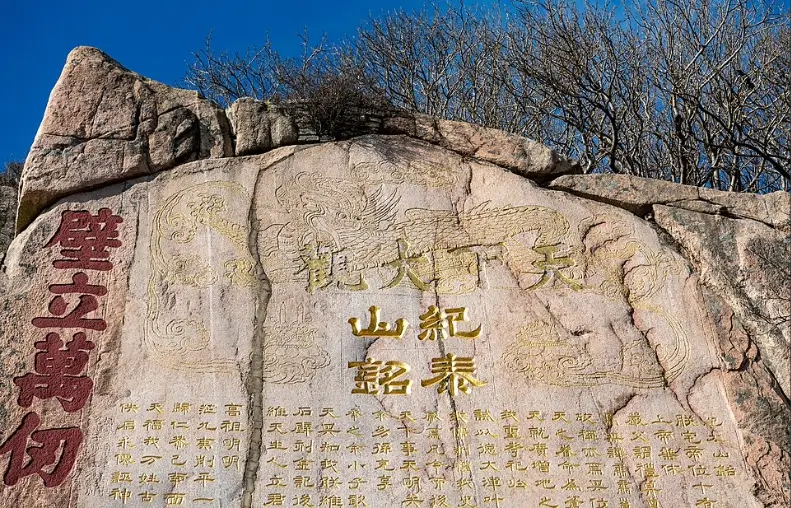
The ascent itself became part of this experience. The traditional route to the summit rises through 6,660 steps, passing ancient gates, arches, pavilions, temples and inscriptions, while the landscape gradually opens with every turn. The physical effort belongs to the journey, although the deeper experience comes from watching the familiar world change as the mountain carries the traveller higher. What appears immense from below can seem small from above. Perhaps much depends on where we stand, and on the perspective from which we look at the world.
What appears immense from below can seem small from above. Perhaps much depends on where we stand, and on the perspective from which we look at the world.
Confucius is traditionally associated with Taishan, and the mountain appears in one of the enduring observations attributed to him: once Taishan has been climbed, the world below appears small. The thought feels particularly at home here, where the physical act of rising alters the horizon and, with it, the proportions through which the world is perceived. From the summit, the plains of Shandong spread beneath the sky, their fields, villages and roads becoming part of a single landscape, while the traveller who has climbed through centuries of inscriptions and sacred places is invited to see the world from a different place within it.
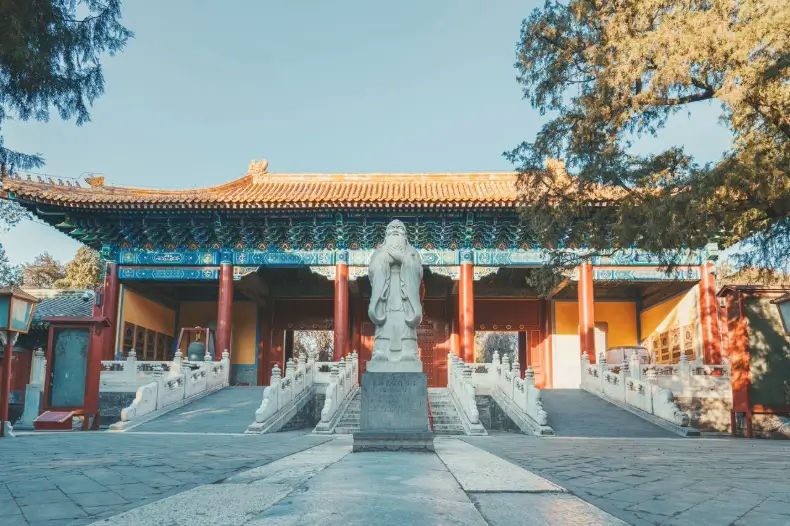
For a mountain so closely associated with Heaven, perhaps the most remarkable thing is how deeply human its history remains. Emperors came carrying the authority of an empire, scholars arrived with their thoughts, pilgrims climbed with their prayers, and ordinary people brought hopes that belonged only to their families. Their reasons differed, their worlds changed, and dynasties rose and disappeared, while the mountain continued to receive them under the same sky.
The ceremonies of the emperors belong to another age, and the political order that once gave them meaning has long since passed into history. Taishan remains within the living landscape of China, its temples still receiving pilgrims, its inscriptions still rising across the stone, its ancient trees still standing beside paths worn by generations of feet. What endures is not simply a collection of historical remains, but a relationship between place and civilization in which nature, belief, philosophy and human life have been woven together for centuries.
Perhaps this is why Taishan cannot be understood through history alone. Its story reaches beyond the dynasties that once gathered upon its slopes, toward a way of seeing in which nature is never merely scenery, the sacred can enter the rhythms of ordinary life, and humanity exists within an order larger than itself. The mountain became a place where history acquired a spiritual dimension and where philosophy could be lived through ritual, pilgrimage and the simple act of climbing.
The mountain became a place where history acquired a spiritual dimension and where philosophy could be lived through ritual, pilgrimage and the simple act of climbing.
For more than three thousand years, people have climbed Taishan carrying prayers, ideas, authority, devotion and questions. The mountain has received emperors and pilgrims, scholars and poets, parents and travelers, while the sky above them has remained open. Each ascent belongs to its own time, although the mountain gives every generation the same path upward and the same widening horizon.
Perhaps this is what a sacred mountain ultimately offers: a way of seeing one's own life within a world that extends beyond it. The summit does not remove the traveller from the earth; it allows the earth to be seen differently. History does not disappear from the landscape; it becomes part of the view, together with the temples, the inscriptions, the ancient rituals and the countless lives that have passed beneath the same sky.
Maybe this is what remains after centuries of climbing the same mountain: the feeling that the world becomes larger as we rise within it, and that somewhere between the earth beneath our feet and the Heaven above, something within us begins to change. Between Heaven and Earth rises Taishan, carrying in its sacred landscape the history of a civilization. As you ascend toward the summit, the path leads to that sacred place where the mountain meets the sky, and where, for a moment, the distance between humanity and Heaven seems to disappear.
Between Heaven and Earth rises Taishan, carrying in its sacred landscape the history of a civilization.
Image Credits
Sunrise at Mt Tai — me (w:User:pfctdayelise) , CC BY-SA 2.5 , via Wikimedia Commons.
50360-Taishan (49055671161) — xiquinhosilva , CC BY 2.0 , via Wikimedia Commons.
50446-唐摩崖刻石-Mount Tai — xiquinhosilva , CC BY 2.0 , via Wikimedia Commons.