There are places on Earth where time settles so deeply that it becomes part of the stone itself, where memory ceases to belong to humankind alone and remains inscribed within the very fabric of the world. The thin veil of mineral varnish that covers the sandstone walls has preserved the traces of a history that neither wind nor light nor the passing of millennia has managed to erase, allowing every fissure, every curve and every surface shaped by erosion to carry forward the marks of a world in perpetual transformation.
In southeastern Algeria, the Tassili n'Ajjer plateau stretches across the desert like an archive where the Earth and humankind have written, millions and thousands of years apart, successive chapters of the same story. Nearly four hundred and fifty million years recorded in its sandstone layers speak of vanished seas, glaciers, rivers and deserts. Upon that geological record, human hands left another testimony to their passage through the world. More than fifteen thousand rock paintings and engravings cover the cliff faces, forming one of the most remarkable visual chronicles of early civilization and preserving the image of a Sahara where water, people and great herds once shared the same horizon.
When the Desert Was a Sea
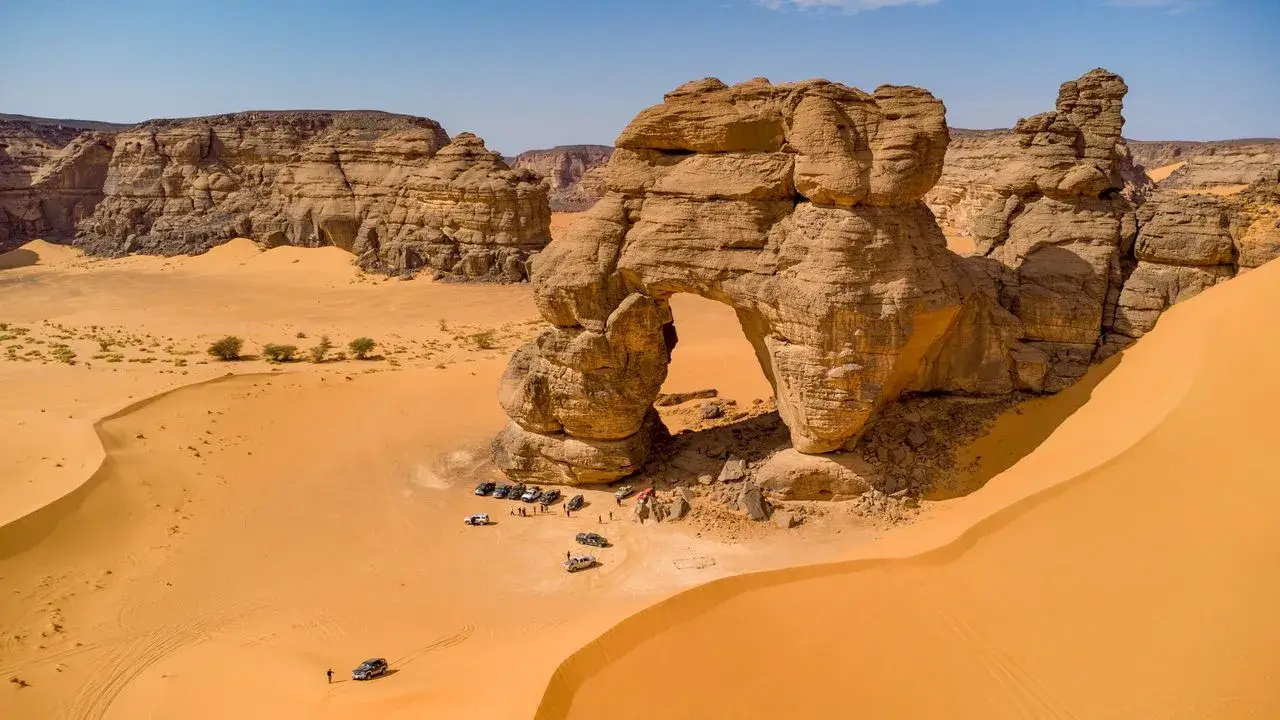
To look upon this plateau is to learn how to read the language of stone, for every sandstone horizon becomes a page in a geological chronicle whose words were composed through millions of years of deposition, upheaval and erosion. In Tamahaq, the language of the Tuareg people, Tassili n'Ajjer means the Plateau of Rivers, a name that echoes today like an elegy for waters that once crossed these valleys, recalling an age that endured for millennia and transformed this landscape into a vast savannah where hippopotamuses and crocodiles, giraffes and rhinoceroses roamed beneath the same sky.
What is now the largest hot desert on Earth lay rested under the waters of an ancient ocean almost five hundred million years ago. During the Late Ordovician, around 445 million years ago, immense ice sheets spread across vast regions of Africa and South America, carving polished surfaces into the soft rock that would one day become the Sahara. Along today's border between Algeria and Libya, spectacular Ordovician glacial pavements still bear parallel grooves and delicate striations left by moving ice, immense fingerprints pressed into stone across countless ages.
When the glaciers retreated, the landscape entered another profound transformation. The glacial plain gave way to a shallow sea, Devonian sediments settled upon the older Ordovician layers, and millions of years of compression slowly turned sand into sandstone. As the plateau gradually rose, water and wind completed the landscape, carving deep valleys, shaping arches and canyons, and raising towering columns of stone that recall forgotten citadels and petrified forests while time continued to pass, quietly admiring its own masterpiece.
Before the wind assumed its patient craft, water had been the great architect of this landscape. Even the name bestowed by the Tuareg — the Plateau of Rivers — preserves the memory of a hydrological world that now seems almost beyond belief. During the Green Sahara period, some ten thousand years ago, subtle variations in Earth's orbit and axial tilt reshaped the African monsoon, allowing seasonal rains to reach far into the continent and transforming the desert into fertile savannah. That long humid chapter came to a close around five thousand years ago, leaving behind little more than the silent traces of ancient rivers.
Today the plateau is hyper-arid, receiving less than one hundred millimeters of rainfall each year. Water has retreated deep underground, lingering only in a handful of temporary gueltas, where life still finds refuge. This extreme aridity, together with elevations reaching between fifteen hundred and eighteen hundred meters, created the conditions that preserved one of humanity's most extraordinary inheritances. Iron and manganese oxides formed a natural varnish across the sandstone, protecting both the sculpted rock formations and the prehistoric paintings that have endured through thousands of years.
In 1982, UNESCO inscribed Tassili n'Ajjer on the World Heritage List, recognizing it as both a masterpiece of nature and one of humanity's most extraordinary cultural legacies, where the history of the Earth and the history of humankind continue to be read within the same layers of stone.
A Library Spanning Ten Millennia
Upon this geological chronicle, human hands inscribed another chapter. More than fifteen thousand paintings and engravings scattered across the sandstone walls form a visual record of both climatic transformation and human evolution, unfolding from around 10,000 BCE to the first centuries of the Common Era.
The earliest period, dating from roughly 10,000 to 7,000 BCE, reveals a Green Sahara alive with hippopotamuses, crocodiles, giraffes, rhinoceroses and elephants—creatures that seem almost unimaginable in today's desert. Somewhere along these cliffs, an anonymous artist pressed a hand against the rock and left behind an ochre imprint, as though entrusting a simple truth to time itself: I was here. I saw this giraffe. I hunted this rhinoceros. I loved this woman. I danced in the moonlight.
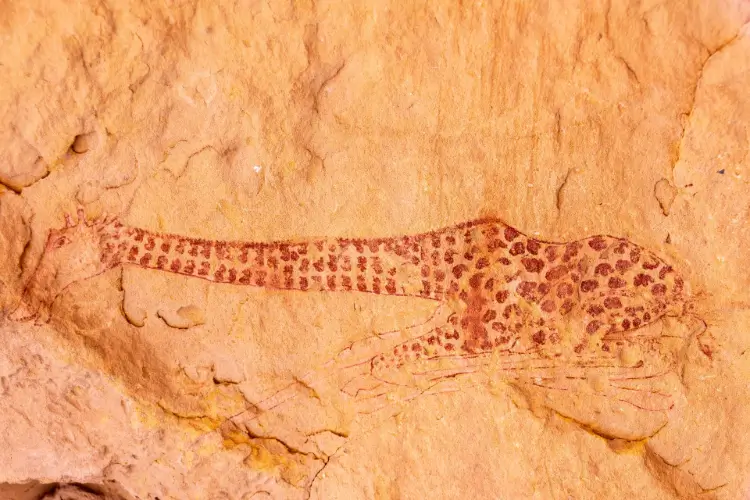
The Pastoral Period, between 7,000 and 3,000 BCE, marks another profound transformation as cattle and sheep become part of the landscape. Among its most enigmatic creations are the celebrated Round Head figures, with their oval bodies and immense eyes, whose meaning continues to elude archaeologists and art historians alike..
From around 2,000 BCE onwards, horses and chariots begin to appear, followed later by the camel, whose arrival reflects the advancing desert and the emergence of trans-Saharan trade. Each period settles like another layer of sediment, each image becomes a sentence, and together they compose a visual narrative of remarkable complexity. The precise dating of these paintings continues to inspire scholarly debate. Some studies place them between 4,000 and 2,000 BCE, while others suggest that parts of this extraordinary gallery may reach back as far as twelve thousand years.
Unpredictable rainfall, rising humidity and increasingly pronounced temperature fluctuations are gradually altering the fragile surfaces of the paintings. Researchers are digitally documenting every image, aware that time continues to write the history of this place and that one day some of its pages may become impossible to read.
Life always finds another way to remain
Time has altered the climate, shifted the waters and reshaped the land. Life has found, each time, another way to remain.
Despite the heat and relentless aridity, the plateau shelters a remarkable diversity of life, sustained by the microclimates created at higher elevations. Nearly half of its plant species are endemic. Among its rarest living treasures stands the Tarout cypress (Cupressus dupreziana), regarded as one of the world's most endangered trees. Some of the last surviving specimens have endured for almost two and a half millennia, each carrying within its trunk the living sap of a climate that vanished long before the modern world emerged. In 2026, researchers identified a new threat to its survival: the moth Pseudococcyx tessulatana, whose larvae infest the cones and drastically reduce the number of viable seeds.
Some forms of life continue only through the memory of the landscape. The West African crocodile (Crocodylus suchus) survived in isolated oueds across the plateau until the early twentieth century. The last recorded individual was seen in the Iheérir Valley in 1924. Today, it has disappeared entirely, remaining only on the sandstone walls, where prehistoric paintings preserve the image of an age when water still belonged to the natural rhythm of this land. Alongside those silent echoes, the Barbary sheep continues to roam the plateau, the last large mammal still living among the species once portrayed by prehistoric artists.
Nature, however, continues to enrich the life of this landscape. In February 2025, researchers described a new species of scorpion, Androctonus ajjer, the forty-second known member of its genus, reminding us that Tassili n'Ajjer still holds pages that science has only begun to read.
The People Who Wrote on Stone
Tassili n'Ajjer remains a living landscape through the people who continue to call it home. The Tuareg of Kel Ajjer, descendants of the Berber communities that have inhabited this region for centuries, still preserve a way of life shaped by the desert and its rhythms.
In 1958, a Tuareg guide named Jebrine ag Mohamed led the French ethnologist Henri Lhote to the rock paintings that would later become known throughout the world. Deeply moved by what he encountered, Lhote devoted years to documenting and interpreting them, describing Tassili as the place where "eight millennia of human history became intelligible through its frescoes."
Life in the local communities continues to revolve around herding and small-scale agriculture, while tourism has gradually become an important source of livelihood. Tassili n'Ajjer also lives through its traditions. The Sebiba festival, born in this landscape and inscribed by UNESCO in 2014 on the Representative List of the Intangible Cultural Heritage of Humanity, carries forward customs passed from one generation to the next, much as the sandstone has carried forward the traces of those who walked here thousands of years ago.
A Treasure Under Human Pressure
Not even time has erased the traces preserved across this landscape. Human hands, however, possess that power within the span of a single generation.
In 2025, the International Union for Conservation of Nature (IUCN) assessed the site as being in "good" condition, while acknowledging a number of growing concerns. During the first ten months of the year, more than twenty-four thousand visitors travelled across the plateau, a number expected to rise following Algeria's introduction of visas on arrival and direct flights between Paris and Djanet.
Opening this remarkable landscape to the world brings both opportunity and responsibility. Tourism supports local communities and contributes to conservation efforts. At the same time, growing numbers of visitors have begun to leave visible marks: acts of vandalism, litter left within protected areas and the gradual erosion of fragile paths. Another concern reaches beyond tourism. Plans for a natural gas pipeline between Illizi and Djanet have raised serious questions among conservation specialists about the long-term integrity of the site.
The immense scale of the plateau—covering almost eighty thousand square kilometres—together with the security challenges of the region, makes its protection an undertaking that extends far beyond Algeria itself. Whatever is lost at Tassili n'Ajjer diminishes a chapter in the shared history of humankind.
What Will Remain After Us?
Before anything else, this plateau is a mirror.
As we look upon these paintings, we encounter the past, our own fragility and the enduring human desire to leave something behind. A Neolithic artist pressed a hand against the rock and quietly declared: I was here. Looking at those same paintings today, we realise that the question no longer belongs to the past. It belongs to all of us.
What will we write upon the stone of our own century? What will future generations read about us?
Among sandstone canyons and layers of ochre, time continues to pose the same question carried by every mark ever left upon the rock.
Between the first handprint and the gaze of someone discovering it thousands of years later stretches an unbroken continuity that time has never undone. Perhaps this is where the true grandeur of Tassili begins.
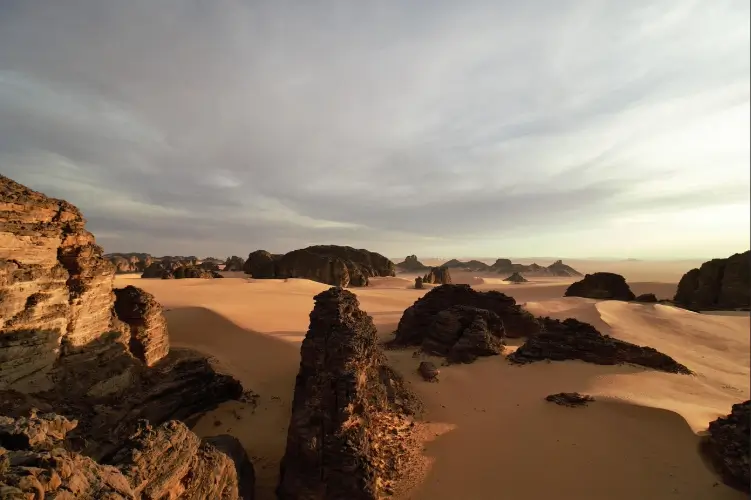
Tassili n'Ajjer writes its history in stone. Geology opens the first page, water and wind carry the story forward, and humankind leaves its mark. In the end, everything becomes time.