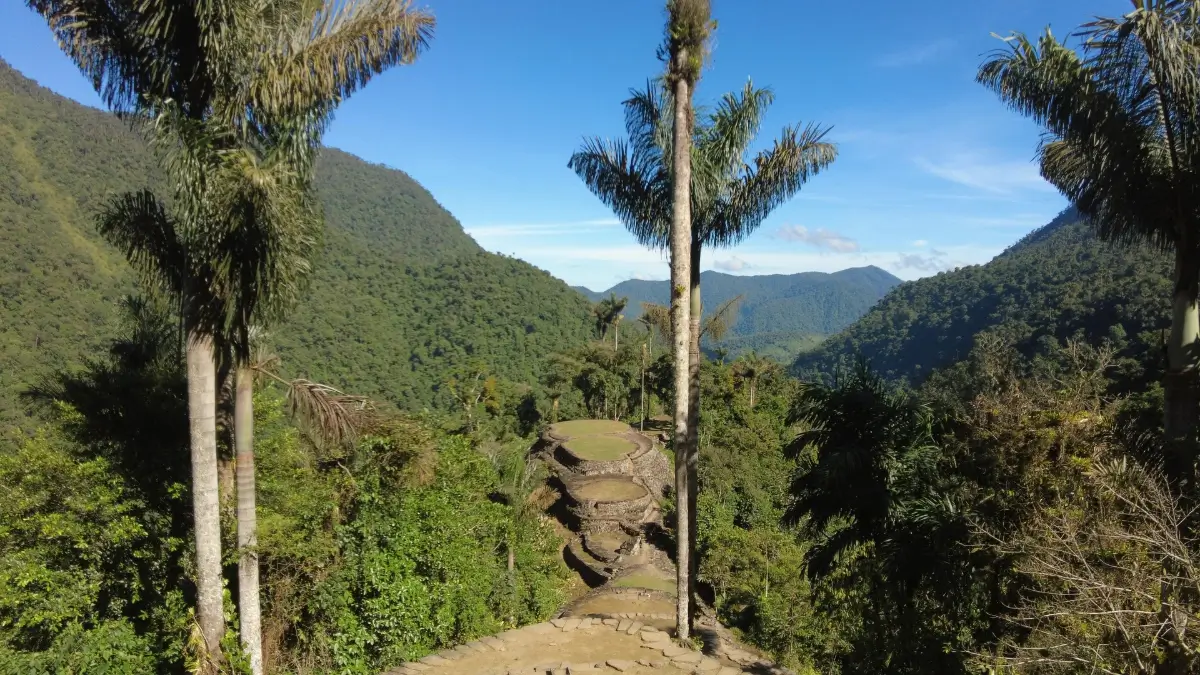
The city of Teyuna reveals itself only to those who go looking for its roots. It rises out of the jungle slowly, like a memory the past has kept hidden, waiting to be seen, to be felt, in the silence that settles after days of walking. In the morning, while the air is still wet and the sun has barely found its way through the leaves, the path opens between shadow, mud, and root. The forest carries the heavy smell of damp earth and of leaves rotting after rain. Then, from every direction, rises the sharp thrum of cicadas — a vast, invisible orchestra that seems to have been playing here long before anyone laid the first stone.
The trail crosses rivers and climbs through the forested flanks of the Sierra Nevada de Santa Marta. Cold water washes the tiredness away for a moment, before the path climbs again. Nights are spent in hammocks, under simple shelters, and morning begins before the light has crossed the ridgeline. After days of walking, when the jungle seems ready to give up nothing beyond itself, the first stone steps appear. Broad, damp, moss-covered, looking as though they had grown out of the mountain rather than been built by human hands. Only then does the city truly begin to show itself. In that moment, history stops being an abstraction, a paragraph in a book. It becomes a physical presence, a place where every step is a page in a book written in stone.
It becomes a physical presence, a place where every step is a page in a book written in stone.
You look up and see the stairways vanishing into a wall of green, climbing further among trees and roots, and what had, until then, seemed no more than a track through the jungle begins to take on the scale of a history the forest has kept hidden for centuries. Around the seventh century — more than seven centuries before Machu Picchu rose in the Andes — the Tairona people were building here, in the heart of the Sierra Nevada de Santa Marta, a city whose terraces, roads, and stone structures would remain in the mountain long after those who built them had vanished.
Teyuna spread across roughly thirty-three hectares, over the mountain's steep flanks, following the shape of the land and linking its different levels through a network of stairways, paved roads, and terraces. More than two hundred structures have been identified here — circular platforms, retaining walls, communal spaces, and drainage systems built to carry rainwater down the slopes. Seen today, this architecture seems almost inseparable from the mountain itself: the steps rise with the gradient, the walls trace the land's own contours, and stone is present wherever people once needed to make room for dwelling, for meeting, for passage.
At Teyuna, the architecture can only be understood alongside the terrain, and the life of the city alongside the water that ran down from the Sierra Nevada.
The houses, built chiefly from wood and plant materials that could not withstand centuries of damp, have vanished almost entirely, while their stone foundations remained behind, marking the places where a community once built its life. From these surviving structures we can reconstruct only fragments of a city that was once far richer in form, and it is this gap between what was organic and what has endured as mineral that makes Teyuna legible today through stone alone: through the circles of its platforms, through its monumental stairways, and through the walls that have withstood the mountain's vegetation, holding the shape of the places where people once set down their homes, met one another, and moved from one level of the city to the next.
Water was woven into the very order of the city. In a territory where rain can turn hillsides into torrents within moments, drainage systems and terracing allowed its inhabitants to work with the movement of water and shape the land for dwelling and cultivation. Each level of the settlement was bound to the next, and roads, terraces, and channels together formed an infrastructure adapted to a mountain in constant motion. At Teyuna, the architecture can only be understood alongside the terrain, and the life of the city alongside the water that ran down from the Sierra Nevada.
Perhaps this is why, looking at what remains, we see more than the ruins of a pre-Columbian settlement: we see the traces of how the Tairona set their lives into the mountain. They built according to the slope of the land, laid stone wherever the hillside demanded support, followed the course of the water, and gradually turned the mountain's steep terrain into a place where people could live, farm, move, and gather. The city took its form in relation to the mountain, and that relationship is still visible in every terrace, in every step that has survived after everything else slowly returned to forest.
There are no Tairona writings to explain this world to us. We have no indigenous chronicles describing the city from within, no inscriptions to tell us what each space once meant. What we do have is the architecture itself, its position on the mountain, the way water was organised, and what the indigenous communities who still hold the Sierra Nevada as sacred ground have preserved across generations. Between these two traces of history — what can be read in stone, and what has been passed down through people — the true story of Teyuna begins.
Between these two traces of history — what can be read in stone, and what has been passed down through people — the true story of Teyuna begins.
The Tairona were also skilled craftsmen, and gold held an important place in their material and ceremonial culture. The pendants, figurines, and ornaments found across the Sierra Nevada speak of a refined metallurgical tradition, in which gold was shaped through sophisticated techniques into objects that carried, beyond their beauty, social and ritual meaning. For the Tairona, precious metal did not belong to a world set apart from the spiritual; the objects they produced — like their ceramics, their textiles, their ornaments — belonged to a culture in which the life of the community was bound closely to ritual, to exchange, and to its relationship with the land.
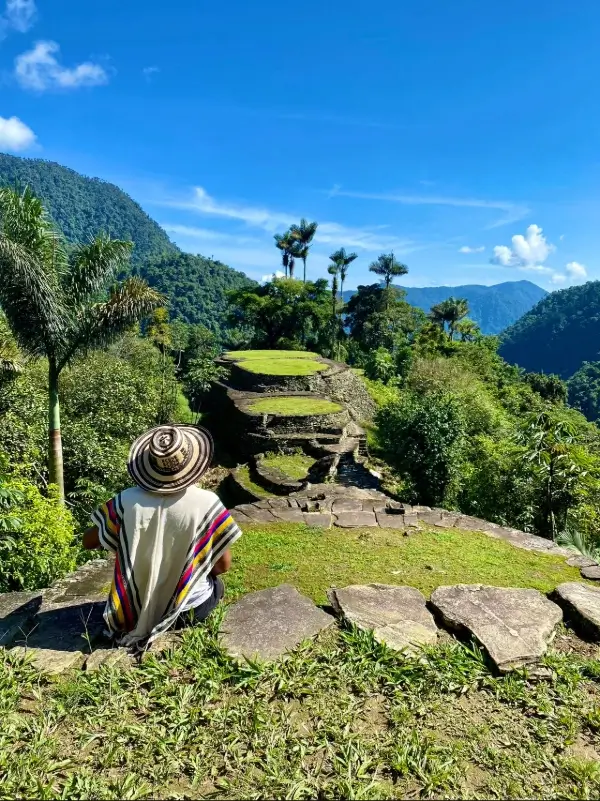
Of how this world understood the sacred, we know rather less. The Tairona left behind no chronicles, no inscriptions to explain their rites, and what can be said of their beliefs must be pieced together from archaeological remains and from what has survived, in living form, in the traditions of the Sierra Nevada's indigenous peoples. The platforms, the terraces, the ceremonial spaces, and the way the settlement was woven into the mountain suggest a society for which the surrounding world carried a significance far deeper than that of a mere natural backdrop.
A mountain once approached by emperors in ceremonies concerning Heaven and the destiny of the realm could also receive the prayer of a parent carrying a private hope for a child. A pilgrim could climb toward the same summit seeking health, protection or a blessing for the family, bringing to the sacred landscape concerns that were deeply personal and entirely human. In these gestures, the vast structures of Chinese cosmology came close to everyday life, and the sacred mountain became a place where the universal and the intimate could exist within the same landscape.
This continuity becomes clearer when we turn to the communities that remained in the Sierra Nevada after the Tairona world disappeared. The Kogui, the Arhuaco, the Wiwa, and the Kankuamo are descendants of the Indigenous peoples who inhabited the Sierra Nevada before and during the colonial period, and they continue to live in this territory, preserving systems of knowledge, practices, and forms of organisation passed down through generations. Despite the pressures of colonisation and later state expansion, they have maintained a significant part of this continuity, at a remove from the colonial centres taking shape along the coast.
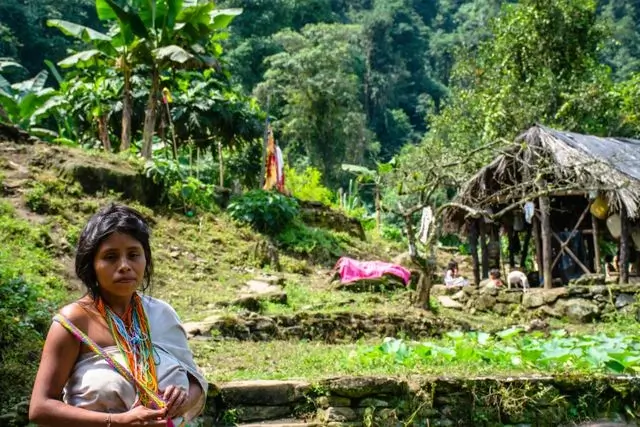
For these peoples, the Sierra Nevada is sacred ground, where mountains, waters, forests, and people form an order that every generation is bound to preserve. The Kogui, in particular, speak of the world through the relationship between the Older Brothers and the Younger Brothers — a distinction through which they express their role as keepers of an order they believe the modern world has forgotten. The Mámas, spiritual leaders of the communities, hold and pass on this knowledge, and pagamentos — the offerings and ritual practices through which balance is restored — remain part of their relationship with the land to this day.
In this vision, the mountain cannot be separated from its waters, nor the water from the life that unfolds around it. Rivers, springs, rocks, forests, and peaks belong to a single web of relationships in which every element carries its own place and its own responsibility. It is a form of knowledge passed down orally, through observation and practice, in which nature is never reduced to mere resource, nor the sacred confined to a space apart from daily life.
Then came the sixteenth century, and the world that had taken shape in the Sierra Nevada over the centuries began to be reshaped by contact with the Europeans. The Spanish reached the Colombian coast and gradually pushed into Tairona territory, drawn by the region's wealth and met by communities that resisted colonial expansion. Conflict, disease, and the economic and political upheavals brought by colonization steadily destabilized this world, and by the close of the sixteenth century, Teyuna had been abandoned.
The city did not vanish in a single moment. Dwellings built of wood and plant matter gave way over time, roads disappeared under fallen leaves, and roots began working their way between the stones. The terraces remained under the forest, the stairways were lost to the undergrowth, and what had once been a city became, for the world beyond the mountains, a place without a name and without a place on any map. For centuries, the jungle did what it does best: it covered the traces of human life without erasing them entirely.
For the indigenous peoples of the Sierra Nevada, however, Teyuna never simply became a lost city. The place remained part of their sacred geography, even as the outside world lost all knowledge of where to find it. Here lies one of Teyuna's most striking contradictions: a city could be declared lost by official history while continuing, at the very same time, to exist within the knowledge and practices of those for whom that ground had never ceased to be alive.
It was not until the 1970s that the outside world drew close to Teyuna again. Treasure hunters — guaqueros — arrived in the region, drawn by the gold and pottery hidden within the city's remains, and their clandestine digging destroyed archaeological contexts, tearing artefacts from the places where they had lain. Teyuna began, in this way, to be rediscovered through what could be seized, long before anyone sought to understand the world to which those objects belonged.
Archaeological research would follow soon after. Following explorations in the early 1970s, the Colombian Institute of Anthropology began systematic work at Teyuna in 1976, undertaking research, conservation, and restoration. The terraces were cleared of vegetation, the structures documented, and the city began reclaiming its place in Colombia's archaeological history. For researchers, it was an extraordinary discovery; for Teyuna, it was only a new chapter in a story that had, in truth, never really ended.
Today, Teyuna occupies a space where two ways of seeing the past meet. Archaeology reads the stone, measures the terraces, traces the roads, and reconstructs what can be recovered of a vanished civilisation. The indigenous communities regard the same place through a continuity that neither begins nor ends with the ruins. For them, Teyuna belongs to sacred ground, and their relationship with the mountain remains one of responsibility, ritual, and belonging.
Perhaps this is the true question Teyuna leaves behind. What happens to a place when history declares it lost, while the people who preserve its meaning have never once considered it so? What do we see when we clear the vegetation from a stone: a ruin, a relic, a piece of archaeological evidence — or the trace of a world that has never let go of its bond with the place?
Perhaps the answer lies in the very way Teyuna survived. Underneath the roots, below the moss, beneath layers of earth and vegetation, the city remained embedded in the mountain; the water still runs down the same slopes, the rain still falls on the same stones, and those who know the mountain still climb toward its sacred places. What remains is a rediscovered city, whose history continues to flow through stone, through water, and through the people who have kept faith with this mountain.
The water still runs down from the Sierra Nevada, the rain still falls on the same stones, and the jungle once again stretches its roots across the walls and steps that have outlasted the centuries. In this landscape, time does not seem to move in a straight line. Its layers still lie one upon another: the Tairona city, the forest that covered it, the archaeologists who uncovered its structures once more, and the indigenous communities who have gone on reading the mountain through knowledge passed from one generation to the next.
From this came the name by which Teyuna would enter the modern world: Ciudad Perdida — the Lost City. A name that tells the story of a world which, for centuries, no longer knew where the city stood. In the mountains of the Sierra Nevada, however, the history of the place lived on through the people who know its ground, through their rituals, through their bond with the mountain.
Teyuna was lost only to maps, to chronicles, to the official memory of the outside world. The stone remained underneath the roots, the water went on running down the same slopes, and the mountain kept the place as one generation gave way to the next.
Today, as its steps rise once more into the light, Teyuna remains there, underneath the roots, while the water continues its descent from the mountain, and history goes on tracing its path among people, stone, and forest.
Perhaps Teyuna was lost only to maps, to chronicles, to the official memory of the outside world.
Sources
Archaeological heritage Parque Arqueológico Teyuna – Instituto Colombiano de Antropología e Historia (ICANH) (2026) . Via ICANH 🔗
Archaeological research and visitor guide Parque Arqueológico Teyuna-Ciudad Perdida. Guía para visitantes – Santiago Giraldo Peláez; Luisa Fernanda Herrera (2019) . Via Fondo Editorial ICANH 🔗
World Heritage tentative listing Tayrona and Sierra Nevada de Santa Marta National Parks and their Archaeological Sites – UNESCO World Heritage Centre (2012) . Via UNESCO 🔗