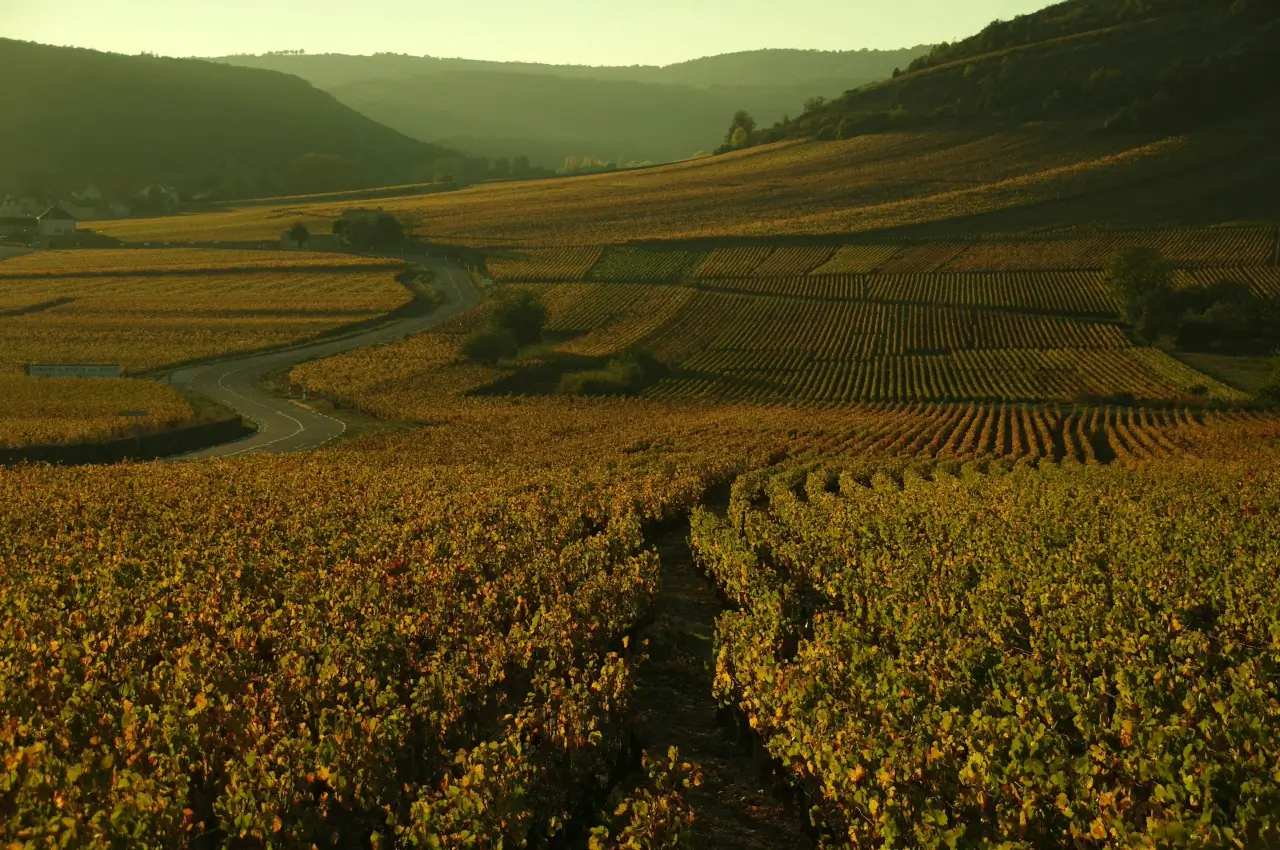
From the Roman legions to the Cistercian monks, and from medieval dukes to modern-day winegrowers, Burgundy has remained one of the world’s most prestigious wine regions. Here, every vineyard plot bears an ancient name, and every wine preserves a connection to the land, to time, and to tradition.
There is a subtle difference between seeing a place and allowing it to change you. In Bourgogne, that difference reveals itself through wine.
Nearly two thousand years ago, when Julius Caesar’s legions were conquering Gaul and dividing it into provinces, the Romans discovered the potential of a land they would come to associate with the cultivation of the vine. On the hills between the Saône and the Loire, where the slopes open towards the sun and the stony, limestone-rich soil is less suited to cereal crops, the vine found favourable ground. The Romans founded Autun and contributed to the development of viticulture in the region, where vine-growing had become established during the early centuries of the Common Era. A written reference to the wines of Autun appears in 312, in a speech addressed to Emperor Constantine — testimony to the reputation these wines had already acquired in Antiquity.
Over the centuries, viticulture continued to develop, and the Burgundians, too, left their mark on the region. In the sixth century, under King Gundobad, Lex Gundobada, the Burgundian law code, recorded a world in which land, property and the order of the community played an essential role. In time, the cultivation of vines on less fertile slopes helped shape a vineyard landscape in which soil and exposure became integral to the identity of each wine.
In Bourgogne, autumn is born anew each year.
For a decisive chapter in Burgundy’s viticultural history unfolded around its monasteries. The Abbey of Cluny was founded in 910, followed by the Abbey of Cîteaux in 1098. Benedictine and Cistercian monks received substantial land grants from local nobles and helped develop the vineyards through careful work carried out over successive generations.
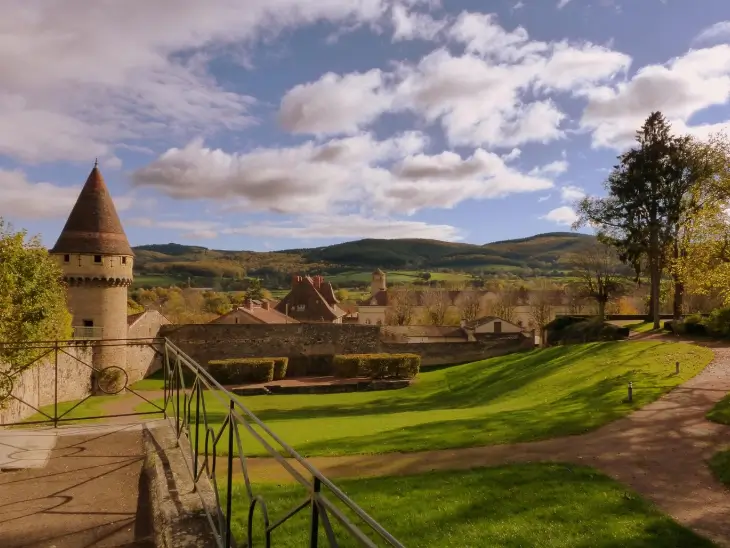
Their prolonged observation of the land, comparison of harvests and understanding of differences between soils brought their work close to an early form of scientific inquiry. Gradually, vineyard plots came to be distinguished according to soil, exposure and microclimate. From this accumulated knowledge emerged the concept of the climat — a precisely delimited vineyard plot with its own identity, recognised and passed down through the centuries.
In 1336, the Cistercians completed the enclosure of Clos de Vougeot, one of Bourgogne’s best-known historic vineyards. The wall that defines its boundaries embodies an idea central to the region’s identity:
A place leaves its mark on the character of its wine.
Between the fourteenth and fifteenth centuries, the Duchy of Burgundy became one of Europe’s most powerful political and cultural forces, rivaling the Kingdom of France. The ducal court in Dijon was a center of art, music and literature, while Burgundian wine had become a symbol of aristocratic prestige.
In 1395, Duke Philip the Bold made a decision that would shape the course of regional viticulture for centuries to come. He ordered the cultivation of Gamay to be restricted in favour of Pinot Noir, which he considered superior. The decree strengthened the association between Burgundian wines and exacting standards of quality, helping define their identity.
Dijon and Beaune became bywords for medieval refinement, with palaces, Gothic churches and an urban heritage that endures to this day. In the stone of these cities lingers the echo of a world that invested in beauty, craftsmanship and forms designed to withstand the passage of time.
In Bourgogne, wine shapes the social calendar and the rituals of community life. The autumn harvest is prepared for throughout the year, while wine festivals mark the rhythms of labour, gratitude and gathering.
On the last weekend of January, Saint-Vincent Tournante, the travelling festival dedicated to the patron saint of winegrowers, brings parades, religious ceremonies and tastings to the village hosting that year’s celebration. In late summer or early autumn, Ban des Vendanges marks the opening of the grape harvest through local ceremonies and festivities.
In Beaune, La Fête des Grands Vins de Bourgogne brings together wines from across the region’s many appellations. In Châtillon-sur-Seine, Crémant et Tape-Chaudrons celebrates the sparkling wine Crémant de Bourgogne with brass bands and a parade in which locals beat on pots and pans, symbolically heralding the arrival of spring.
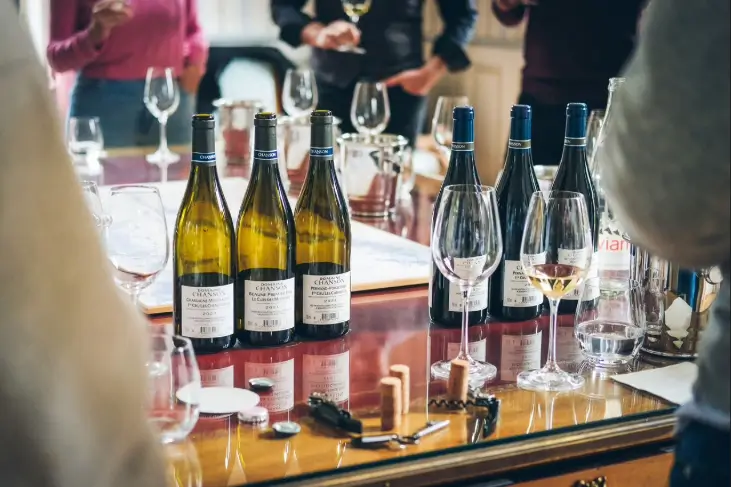
Through these rituals, the community renews its bond with the land and the labour behind every harvest. The vine demands care throughout the year, while the wine it yields requires time and patience before it reaches the table.
Burgundian cuisine is inseparable from wine. Food and wine belong to the same landscape, bringing together the bounty of vineyards, pastures and forests. Signature dishes such as coq au vin, bœuf bourguignon and escargots de Bourgogne, along with Dijon mustard and cheeses such as Époisses, express the diversity of a region whose cuisine has evolved in close relationship with its local produce.
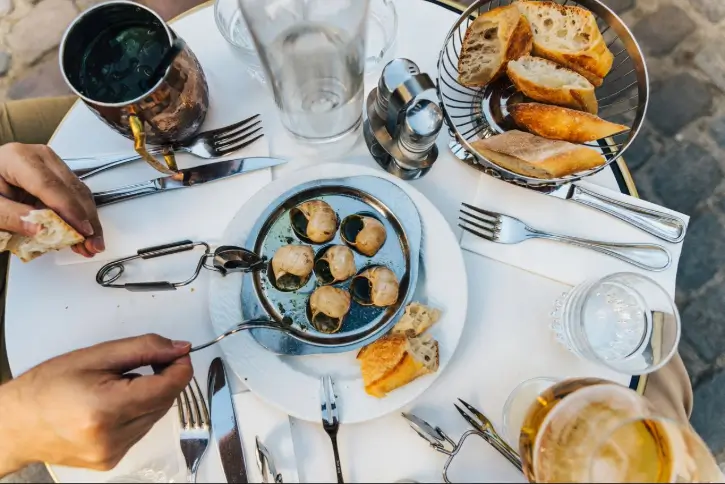
Meals in Bourgogne are leisurely and convivial, built around regional ingredients and the interplay between food and wine. A Pinot Noir might accompany roast duck, a mineral-edged Chardonnay might complement a shellfish dish, while a Crémant de Bourgogne might open the meal with its freshness. Each pairing brings a different facet of flavour and terroir to the fore.
Here, wine becomes an occasion for gathering, a way of letting time flow naturally and harmoniously around the table.
In 2015, “Les Climats du vignoble de Bourgogne” were inscribed on the UNESCO World Heritage List in recognition of a cultural landscape shaped by centuries of labour, observation and the transmission of knowledge. The system of historically defined vineyard plots expresses the deep relationship between local communities and the land they cultivate.
Burgundy remains one of the world’s most prestigious wine regions. Pinot Noir, the signature grape of its red wines, and Chardonnay, the benchmark for its whites, continue to express the subtle differences between individual plots. A Pinot Noir from Romanée-Conti has a distinct identity from one produced in Gevrey-Chambertin, even though the two places lie only a few kilometers apart. These differences are the result of a long relationship between soil, climate, grape variety and the human hand.
Every plot bears an ancient name, every village preserves its Romanesque or Gothic church, and many vineyards are bound to the history of a monastic order, a duke or a family of winegrowers. In Bourgogne, the end of autumn gives way to a new cycle. The vine’s roots remain in the earth, and spring will return, bringing a fresh beginning.
Empires fade over centuries, while autumn in Kanas retreats within twenty days.
In Bourgogne, time leaves its mark on every harvest, and the autumns gather, one by one, in every bottle of wine.
To open a bottle of Bourgogne is to encounter two thousand autumns held within a single wine. And that is, after all, an Art.
Sources
Official UNESCO World Heritage documentation on the vineyard parcels, terroir, historical development and cultural landscape of Bourgogne. The Climats, Terroirs of Burgundy – UNESCO World Heritage Centre (2015) 🔗
Historical background on Roman-era viticulture, the written reference to Autun in 312, and the role of Cluny and Cîteaux in the development of the vineyards. Bourgogne: Born Under the Roman Empire, Raised by Monks – Bourgogne Wine Board (BIVB) 🔗
Historical context on medieval monastic viticulture, the influence of the Burgundian dukes, and the development of the region's wine identity. From the 5th to the 15th Century: Wines Made by Monks and Promoted by the Dukes of Bourgogne Across Europe – Bourgogne Wine Board (BIVB) 🔗
Reference for the 1395 edict of Philip the Bold restricting Gamay in favour of Pinot Noir in the Duchy of Bourgogne. Gamay: A Varietal with a Southern Accent – Bourgogne Wine Board (BIVB) 🔗
Reference for the wine festival in Beaune and the range of appellations represented across Greater Burgundy. 153rd Fête des Grands Vins de Bourgogne – Beaune and the Beaune Region Tourism Office (2026) 🔗
Cultural and regional context for Saint-Vincent Tournante and Burgundy's wine-related community traditions. Six Major Events for Tasting Burgundy Wines – Beaune and the Beaune Region Tourism Office 🔗