Somewhere in the heart of Asia, where the borders drawn on maps dissolve among the ridgelines and the mountains rise so high that the clouds seem to sleep upon their summits, lies a lake set between four worlds. Here, autumn displays its colours for just twenty days, beginning in mid-September and lasting until early October, when the first snow settles over the forests, covering them in a veil of white. The Altai Mountains rise like sentinels over this land, between Kazakhstan, Russia, Mongolia and China, and Kanas lies within this vast meeting ground, at the crossroads of four distinct geographies. Here, the wind crosses the borders drawn on maps, while migratory birds glide freely through the air, passing from one country to another without ever knowing they have crossed a frontier.
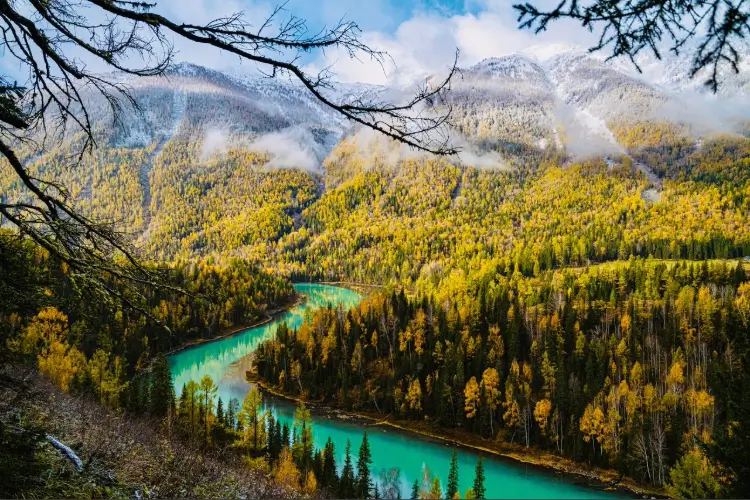
The journey here is arduous and must be made in stages. From Ürümqi, the capital of Xinjiang, the road stretches for nearly eight hundred kilometers and takes around two days, winding through landscapes that change with every bend. Alternatively, a ninety-minute flight brings travelers to Burqin Kanas Airport, a small airfield built at an altitude of 1,188 meters, opened in August 2007 and located just fifty kilometers from the lake. From there, the hardest part of the journey begins. Private vehicles are restricted within the reserve, and the only way to reach the wooden villages at the foot of the mountains is by shuttle bus. Those who arrive here feel they have crossed an invisible threshold, leaving one world behind and entering another, along a road that climbs ever higher, narrows between the mountains and winds its way through white mist.
Here, the wind crosses the borders drawn on maps, while migratory birds glide freely through the air, passing from one country to another without ever knowing they have crossed a frontier.
In Kanas, in Xinjiang Province, autumn lasts twenty days.
Lake Kanas lies cradled between the mountains like an immense mirror in which the sky changes its colours three times a day, the water answering each shift in the light. In the morning, it appears pale green, almost the colour of mint. By midday, its waters take on the deep blue of sapphire, while towards evening, as sunlight glides across its surface, a silvery sheen seems to lift the lake and set it in the sky. Those who see the lake at midday may return a few hours later and barely recognize the landscape. The wind raises small waves, clouds drift past and cast their reflections upon the water, and leaves float across its surface, changing its appearance in a matter of moments. At a depth of 188.5 meters, the lake receives and reflects the light like a precious stone whose colour shifts with every change in illumination.
The forests that descend from the mountains to the water’s edge form one of the southernmost extensions of Siberian-type ecosystems, which stretch from Siberia towards northern Europe. Autumn transforms them into a landscape of rare intensity. Birch trees shimmer in luminous golden, seemingly burning without a flame, while Siberian larch turns from the fresh green of summer to a softer, warmer gold, as though the trees had absorbed the light of the entire summer and stored it in their needles. On the ridges, where the air is colder and autumn arrives sooner, the leaves turn yellow several days earlier. Autumn’s colours descend from the peaks towards the valley like a receding tide, gradually leaving behind a different shade of forest. Those who set out in the morning find a golden landscape; when they descend in the evening, everything has shifted to copper. Anyone who looks upon the lake and the surrounding forests can understand why specialists who have studied the area have described its geological, biological and aesthetic value as outstanding on a global scale. Here, all three dimensions of the landscape converge within the same twenty-day window.
Before sunrise, morning mist rises from the lake, as cold air meets the warmer water, giving birth to a thin veil that floats above the surface and slips between the larch trunks. Small islands in the bays appear and disappear; the mountains lose their outlines, only to emerge slowly from the white veil once more. The landscape seems suspended between two states, between dream and wakefulness. As the sun climbs higher, it gradually disperses the mist, and the lake regains its colour and brilliance.
Autumn’s colours descend from the peaks towards the valley like a receding tide, gradually leaving behind a different shade of forest.
Here in Kanas, autumn lasts twenty days. It begins around mid-September, when autumn descends from the mountain ridges towards the valley, gradually turning the birch forests golden. The lake shifts from summer green to autumn blue, and the season comes to an end in early October, when the first snow settles over the forests and covers them in white. The cold begins to take hold of the lake, and its surface slowly loses its lustre, preparing for winter.
The forests that descend from the mountains to the lake’s shore shelter a world governed by unwritten laws. The brown bear, the “king of the forests”, forages among the berry thickets and woodland clearings before retreating to dens dug under ancient roots. Packs of grey wolves roam the dense forests, while the lynx, a shadow of the taiga, stalks its prey without making a sound. Elk move heavily through the undergrowth, and the Altai ibex climbs sheer rock faces with a sure-footedness that defies gravity. The snow leopard, one of the most elusive creatures of these mountains, inhabits the high reaches of the Altai. Golden eagles and falcons circle above the lake, surveying the land from on high.
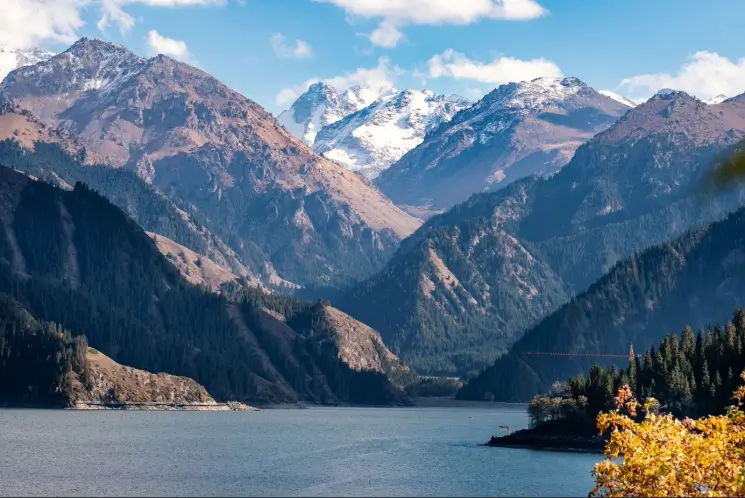
The lake, 188.5 meters deep, sustains fish adapted to cold, Arctic-like waters. Among them lives the Altai osman, a rare fish around which local tales have gathered, drawing the interest of researchers, while the lake’s depths continue to hold many unknowns. Legend has it that a monster lives in the lake. The Tuvans, the people of this region, call it hobzhk, a word said to mean “changeable” or “strange”. According to one version of the legend, these beings kept the lakebed sealed and prevented the lake from draining away. The task was so important that, eight hundred years ago, Genghis Khan is said to have appointed 126 soldiers to guard them.
The mystery remains suspended above the water, like the morning mist that rises slowly, then vanishes without leaving a trace.
Modern accounts of the Kanas monster first emerged in 1985, when professors and students from Xinjiang’s biology faculty reportedly saw enormous red creatures, between ten and fifteen metres long, moving across the lake’s surface. Since then, reports of these apparitions have fed one of the lake’s most enduring legends. Researchers have suggested that the creatures might have been specimens of Hucho taimen, an unusually large freshwater fish that some sources claim can reach remarkable lengths. This identification, however, has not been confirmed as an explanation for the reported sightings. The mystery remains suspended above the water, like the morning mist that rises slowly, then vanishes without leaving a trace.
Here in Kanas, autumn lasts twenty days.
Along the shores of Lake Kanas, where the forests descend to the water and mist rises above the waves each morning, a people have lived for nearly four centuries, preserving an entire history within a handful of wooden villages. They are the Tuvans, whom some local accounts describe as the “guardians of Genghis Khan’s treasure”. Legend has it that the conqueror himself left a guard of chosen soldiers here to protect a treasure hidden either in the depths of the lake or in the surrounding forests. Today, China’s Tuvan population numbers around 2,500, most of whom live in three settlements — Hemu, Kanas and Baihaba — tucked among the Altai Mountains, in the northernmost reaches of Xinjiang Province, near China’s borders with Kazakhstan, Russia and Mongolia. Across the world, the Tuvan population numbers several hundred thousand, most of them living in the Republic of Tuva in Russia, north of Mongolia. The community here is one of the Tuvan communities living outside the Republic of Tuva, and its geographical isolation has helped preserve distinctive traditions and ways of life.
Tuvan history is a history of the margins, of a people who have lived between empires over the centuries, never wholly belonging to any one of them.
Tuvan history is a history of the margins, of a people who have lived between empires over the centuries, never wholly belonging to any one of them. Scholars have yet to reach a consensus on their precise origins, and several hypotheses have been put forward to explain the formation of the Kanas community. Some suggest that its ancestors migrated from the Republic of Tuva around five centuries ago; others link them to groups of Mongol origin associated with Genghis Khan’s campaigns, who may have remained in the region; still others trace the community’s roots to the older history of Turkic peoples in the Altai–Sayan region. These hypotheses reflect the historical complexity of a population shaped at the meeting point of several worlds. What is known is that the Tuvans speak a Turkic language, while in China they are officially registered under the ethnic category “Mongol”. This administrative classification does not alter the Turkic affiliation of the Tuvan language, nor the cultural identity the community continues to preserve. The Manchu Qing emperor Qianlong, who reigned in the eighteenth century, referred to the Tuvans as “Urianhai”, while Qing administrative documents from the Qianlong period mention populations under various names associated with the Uriankhai, illustrating how the imperial administration recorded the peoples of this region using labels and categories that varied according to period and administrative context.
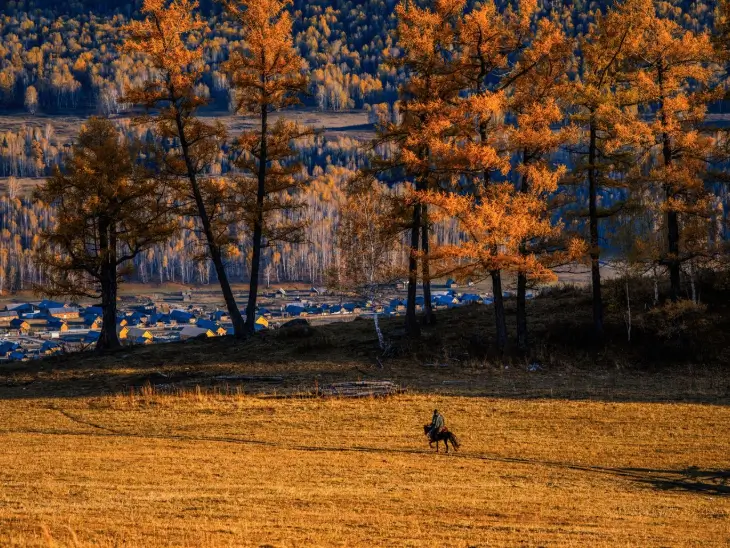
Life among the Tuvans of Kanas has always been shaped by the seasons. They live in communion with the changing year, their herds and the wild, and this bond with nature is a necessity that has shaped every gesture and every celebration. In winter, the Tuvans live in wooden villages at the foot of the mountains, in houses built from thick red pine logs, their sloping roofs sheltering chimneys from which smoke rises slowly. In summer, they move towards the pastures, from lower elevations to alpine meadows, where they live in yurts — the round tents of nomadic peoples — and tend herds of sheep, goats, horses and, occasionally, yaks, moving from place to place in search of grass and water. In autumn, as the forests take on shades of gold and copper and the lake changes colour, the Tuvans return from the pastures with their herds. They gather firewood for winter, make cheese and fermented milk, and their villages fill with the smell of smoke and the sound of horses’ hooves clattering along the earthen lanes. With the arrival of winter, snow and cold draw them back around their hearths, into the shelter of their wooden homes.
They live in communion with the changing year, their herds and the wild, and this bond with nature is a necessity that has shaped every gesture and every celebration.
Tuvan belief brings together Tibetan Buddhism and shamanic and pre-shamanic practices preserved across generations. This combination leads the Tuvans to regard every mountain, river and lake as a place alive with spirits and the forces of nature. They believe in the spirits of particular places, the masters of the mountains, and the powers of fire and water. Their rituals preserve traces of a cosmology in which the natural and spiritual worlds remain closely intertwined. Through these rites, they give thanks for their herds, their hunt, their health and their lives.
Their rituals preserve traces of a cosmology in which the natural and spiritual worlds remain closely intertwined.
Fire is sacred to the Tuvans, and the hearth occupies a central place in both the spiritual and family life of their homes. Fermented milk, turned into a mildly alcoholic drink, is regarded as a ritual offering, presented first to the spirits and then shared with people. The Tuvans still preserve the tradition of reading the signs of nature: listening to the wind, watching the clouds and interpreting the signs they offer. This wisdom is acquired over years spent tending herds on the pastures, through nights beneath a star-filled sky and by listening to the words of the elders.
Music is the soul of the Tuvan people. They have developed one of Central Asia’s most distinctive vocal traditions: throat singing, known as khoomei. A single singer can produce two or even three sounds at once — a low fundamental tone with a second, higher sound above it, like a whistle floating over a voice as deep as distant thunder.
The Tuvans say that people learned to sing this way by observing the world and listening to it attentively, and that every song is a gift offered by humankind in return to nature.
This singing is closely bound to the soundscape of the Tuvan world: the wind moving among the rocks, water flowing over stones, birds announcing the morning. The Tuvans say that people learned to sing this way by observing the world and listening to it attentively, and that every song is a gift offered by humankind in return to nature.
Their traditional instrument is called the suer, a simple wooden wind instrument whose sound resembles the voice of the wind. Today, young Tuvans are learning to carry this vocal and instrumental tradition forward, passing it from one generation to the next like the fire preserved in the hearth.
Over recent decades, life among the Tuvans of Kanas has changed more profoundly than it did across many generations before them. Tourism has reached this remote region, and the wooden villages have begun to welcome visitors who want to see how local people live, taste their cheeses and fermented milk, listen to their songs and buy souvenirs. This opening to the outside world has brought greater prosperity, better access to education and healthcare, improved infrastructure and electricity — but it has also raised difficult questions.
Young Tuvans increasingly leave for the cities to study or work. Those who remain wonder how long they will be able to preserve their traditions in the forms inherited from earlier generations, how long they can continue to depend on their herds and pastoral livelihoods, and how long their language and customs can endure in a world changing so rapidly. Preserving their language and cultural identity remains one of the principal challenges facing the Tuvan community in China.
Songs, rituals and gatherings bind the present to the legacy of those who came before.
Even so, the Tuvans of Kanas endure and adapt, finding a balance between preserving what they have inherited and welcoming what comes from outside, between remaining true to themselves and sharing their way of life with others. Each autumn, as the forests turn golden and the lake changes colour, their lives once again fall into step with the season. Songs, rituals and gatherings bind the present to the legacy of those who came before. For the Tuvans of Kanas, autumn is the season in which their world renews its bond with the land.
I have looked upon Lake Kanas, which changes colour three times a day; forests that blaze with gold and copper for twenty days each year; a wild world governed by laws no one has written; and a people who preserve their traditions from one generation to the next. All of this unfolds in a remote corner of the world, where the mountains rise so high that clouds seem to sleep upon their ridges. Autumn here is a window that opens briefly and closes without warning, leaving behind the memory of colours that the eye has encountered and the heart has kept.
In “Empires in Autumn”, we followed four worlds as they changed over the course of several centuries. In Kanas, change takes twenty days. Empires fade slowly, like a light dying in the sky, while autumn here retreats almost all at once, carrying away the forest’s final colours.
However, both are expressions of the same change, both are faces of autumn. Which is more real: the one you see with your own eyes and lose within a week, or the one you feel unfolding through time and recognize only after it has passed?
In Kanas, autumn lasts twenty days. The leaves fall, the lake freezes, snow covers the forests, and the world awaits a new beginning, a new spring, a new cycle. In this waiting lies one of autumn’s great lessons: every retreat prepares the way for a new beginning. Autumn fades in Kanas, and the world that rises from it bears the imprint of colours that, even as they return each year, are never repeated in quite the same light.
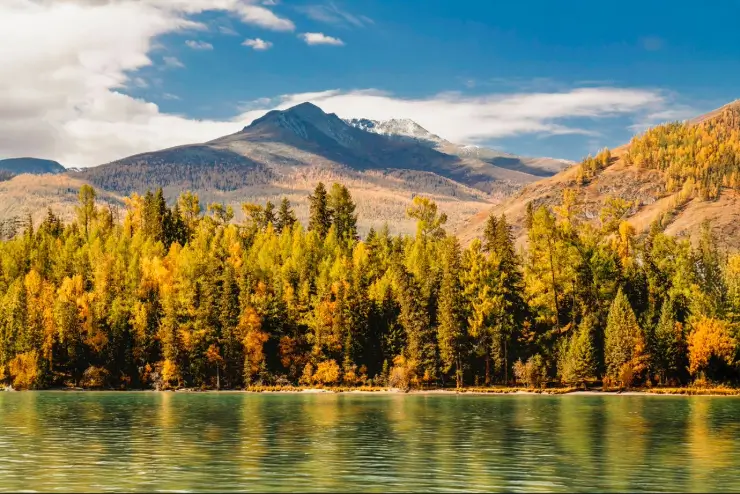
When an empire fades, another world rises from its autumn. When autumn fades in Kanas, another world rises from its leaves.
Sources
Geographic, ecological and cultural background China Altay – UNESCO World Heritage Centre (2010) . Via UNESCO World Heritage Centre 🔗
Geographic and geological data Kanas Lake, Burqin County, Altay Prefecture – Xinjiang Uygur Autonomous Region Department of Natural Resources (2023) . Via Xinjiang Department of Natural Resources 🔗
History, population, settlement, identity and contemporary life Tuvans in 21st century China: history and contemporary situation – Zhanna M. Yusha (2017) . Via The New Research of Tuva 🔗
Cultural and historical background Influence of the Chinese culture on the traditional life of Tuvans – Anna O. Dyrtyk-ool and Solangy Yu. Chyrgalan (2012) . Via The New Research of Tuva 🔗
Historical and ethnographic background Tuvan's genesis. Historical background – Zoia V. Anaiban and Mongush H. Mannay-ool (2013) . Via The New Research of Tuva 🔗
Contemporary community, settlement history and cultural background Live: Visit China's only Tuvas Village – CGTN (2018) . Via China Global Television Network (CGTN) 🔗
Historical and documentary evidence concerning the Uriankhai people in Qing-period records Manchu-Chinese Imperial Maps and Historical Documents Relating to Tuva . Via The New Research of Tuva 🔗