The mysteries of history are mirrors reflecting the imprints of the past across the centuries.
There are thousands of such mirrors, waiting for people to decipher them. Some treasures, thousands of years old, remain buried in the earth, at the bottom of oceans, or in places forgotten by the world, where no one would think to look. Others surface by chance… The mirrors of history are reflected in our memories, preserving within them those historical ages in which treasures were swallowed by the fury of seas and oceans or buried deep in the earth, to remain hidden through the centuries. Like a secret, a mystery known only to history itself. And yet history has shown us that it is itself an enigma to us, and that, in order to be unravelled, it directs its steps toward those who devote their lives to seeking its meaning.
Thus began the mystery of the island of Antikythera…
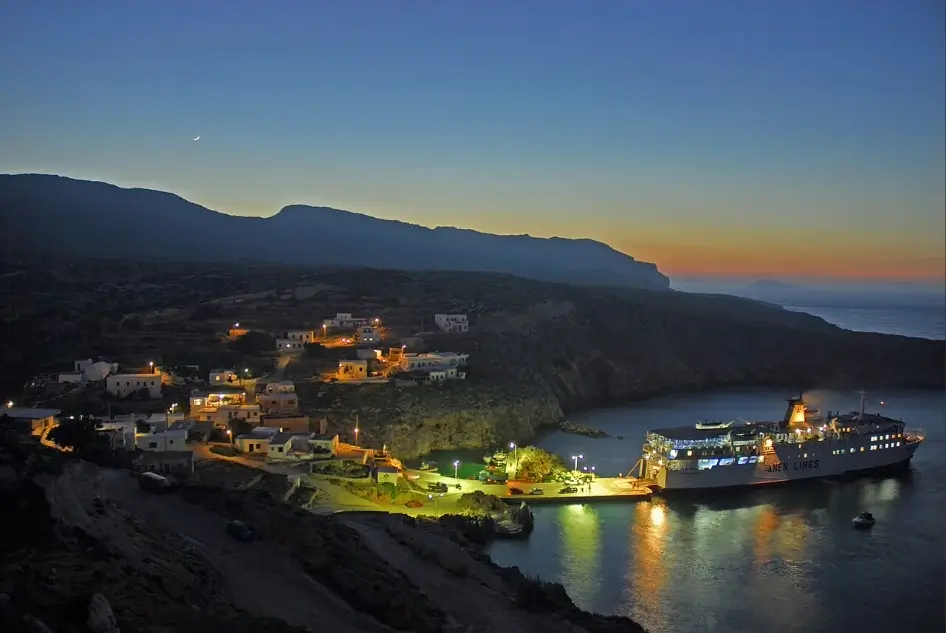
In the autumn of 1900, the Aegean Sea changed the course of an entire history through its desire to be deciphered. A crew of Greek sponge divers, returning home after a long summer spent along the coasts of North Africa, was caught offshore by a storm that seemed to have descended from the sky as a punishment; to find shelter, they dropped anchor near the small, rocky island of Antikythera, a place forgotten by the world, halfway between the Peloponnese and Crete. The sea, which had carried them for months on its waves, now pushed them toward a shore no one had set foot on for centuries. What seemed a simple forced stop would become, years later, one of the most disturbing discoveries of antiquity.
Captain Dimitrios Kontos and his crew were men of the depths, accustomed to darkness, to the oppressive silence of the sea, and to the patience required to explore the seabed. When the storm subsided, they decided to go into the water so as not to lose a whole day’s work, and one of them, Elias Stadiatis, dived first. Shortly afterward he returned to the surface in a state of extreme agitation, telling of a crowd of “dead, naked women” lying on the seabed. To see for himself, the captain went down in turn and immediately understood that on the seabed lay bronze and marble statues of inestimable beauty and value, lying among the wreckage of an ancient ship sunk almost two thousand years earlier, as if time had decided to hide its treasure in a coffin of water and silence.
Written history and lived history were meeting at last on the seabed.
The discovery was spectacular, and in the months that followed the divers were to recover an astonishing treasure: bronze and marble statues, jewelry, furniture, weapons, armour, luxury glass objects—the entire cargo of a ship that had once crossed the seas with the splendour of a world preparing to enter history. The recovery, however, would exact a price no one had anticipated. The divers worked in heavy suits, with copper helmets and air pumped from the surface, and at a depth of fifty metres they could remain no more than ten minutes. Ascents had to be made slowly, with staged stops, otherwise their blood filled with nitrogen bubbles and their joints locked. Several divers were left paralysed; one even lost his life. The bronze treasure of autumn was to be paid for with young bodies. Among all these wonders, a single object went almost unnoticed: a lump of corroded bronze, covered with shells and algae, which was taken to Athens with the rest of the cargo and left for months in a museum courtyard, in a forgotten crate among the objects awaiting examination.
The sea is the only archive that knew how to cover and preserve it.
It was only after the bronze casing cracked, owing to drying and temperature changes, that someone noticed what lay inside: gearwheels, tiny toothed mechanisms cut with astonishing precision, axles, pointers and inscriptions—an entire mechanism emerging from its bronze shell like a bird from an egg. The man who understood what lay hidden in the lump of bronze was the archaeologist Valerios Stais, who in 1902 noticed a gearwheel among the corroded fragments. From that moment the lump of bronze began to become a wholly unusual object: a machine of a complexity the modern world did not expect to encounter in antiquity. It was something the ancient world should not have possessed, an object that contradicted everything known about Greco-Roman technology. Since then no similar example has been found, neither in Greece nor in Rome nor anywhere else in the ancient world. The object would become known as the Antikythera Mechanism, and its mystery would fascinate researchers for more than a century.
A Clockwork of the Heavens
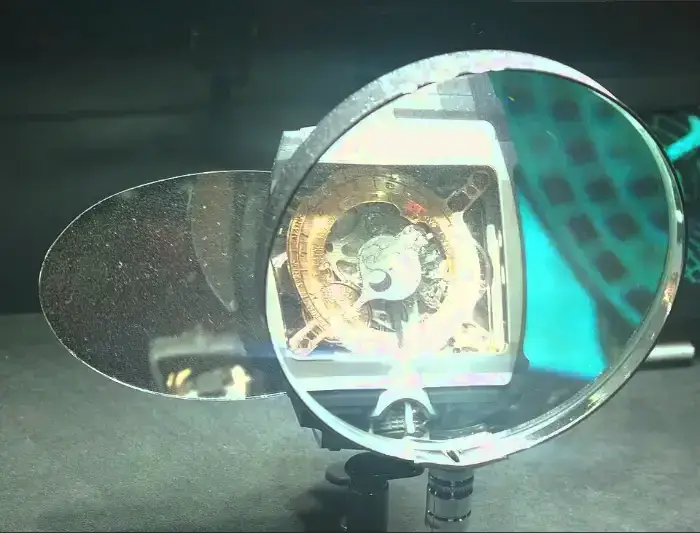
What this object actually was remained a question no one could answer with certainty, and the answer would take shape only slowly, like an archaeological excavation in the minds of researchers. The Mechanism was a portable device, the size of a modern laptop, made of bronze and mounted in a wooden case, and inside it concealed a network of at least thirty gearwheels, connected in a system of astonishing complexity for antiquity, conceived as if by a mind that had understood that the movement of the entire universe could be reproduced in so small an object. It was an astronomical calculator, the first known analogue computer in history, an instrument that turned the sky into numbers and the motion of the stars into gears. One of its most important gears had 223 teeth, cut one by one with a precision that, to a modern eye, seems impossible without high-performance machine tools.
It was an astronomical calculator, the first known analogue computer in history, an instrument that turned the sky into numbers and the motion of the stars into gears.
With the help of these wheels, the mechanism could calculate and display the positions of the Sun and the Moon and, according to some researchers’ interpretations, those of the planets then known. It could predict solar and lunar eclipses, track the phases of the Moon and even calculate the dates of the ancient Olympic Games, thus linking the sky to the human calendar and astronomy to the course of social life. The inscriptions on its casing, deciphered only in the twenty-first century with the aid of X-rays and surface imaging, described a model of the cosmos in which the planets moved on rings and their positions were indicated by small spheres—a universe in miniature turning in a man’s hands. The inscriptions amounted to a veritable user’s manual: they explained the movements of the planets, the meaning of the dials and how the device was to be used. So complex an object came with instructions, like any technology trying to make itself understood.
What is most astonishing is the thought behind the execution, the mathematical patience of the one who cut each tooth with a watchmaker’s precision and conceived each gear as a sentence in a cosmic text. The mechanism incorporated irregular variations in the movements of celestial bodies, such as the changing speed of the Moon across the sky, a phenomenon Greek astronomers knew and attributed to Hipparchus; to reproduce this irregularity, the builder used an ingenious “pin-and-slot” system that transformed uniform circular motion into variable motion. A special gear, called the “draconic” gear, allowed the prediction of eclipses with remarkable accuracy, taking into account the inclination of the Moon’s orbit to the plane of the ecliptic, while the inscriptions mentioned the Olympic Games and complex calendrical cycles, such as the nineteen-year Metonic cycle, the Callippic cycle and the Saros cycle. In a world without mechanical clocks, such an object must have seemed useful, almost miraculous—a gift of the gods slipped into human hands.
An Enigma of Origins
Although it is unanimously accepted as ancient, the Antikythera Mechanism still retains part of its mystery today. Who built it, and where did this extraordinary invention come into being? The wreck in which it was found is dated to around 70 BC, and the mechanism is thought to have been built between 150 and 100 BC, although some researchers suggest that the beginning of its calendar might indicate an earlier date, around 205 BC, which would bring the object closer to the age of Archimedes. Over time there have been speculations that it might have been the work of Archimedes himself, of Hipparchus or of Posidonius, each of them renowned astronomers and mathematicians of antiquity, but none of these attributions could be proved, and the builder’s name has remained hidden in the shadow of time. And yet there is a written testimony. Cicero, in De Re Publica, describes a bronze sphere made by Archimedes that imitated the movements of the Sun, the Moon and the five planets. For centuries this text was read as a description of a lost wonder, without anyone being able to suspect how close it was to reality. Written history and material history were meeting at last on the seabed.
A more recent discovery brought a new lead: certain astronomical and calendrical clues on the mechanism have fed the hypothesis of a connection with the island of Rhodes, an important astronomical centre of the Hellenistic age, famous for its school of astronomy and for its links with Hipparchus. Rhodes may be the place where the mechanism was conceived or built, though this hypothesis has not been definitively proved. The builder’s identity remains, for the moment, an enigma. What we know with certainty is that the Mechanism represents the result of a technical and scientific tradition accumulated over several generations, a tradition that, paradoxically, left almost no other material trace.
Although it is unanimously accepted as ancient, the Antikythera Mechanism still retains part of its mystery today. Who built it, and where did this extraordinary invention come into being?
The Echo of a Lost World
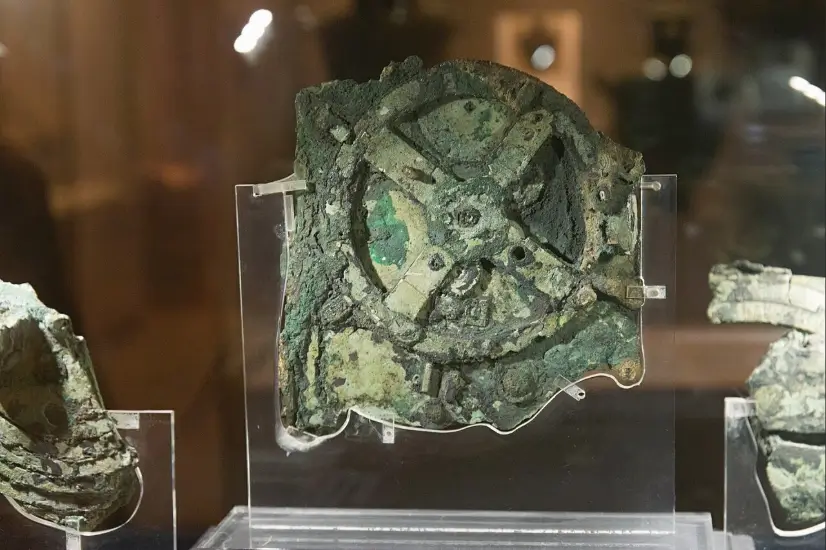
Today the Antikythera Mechanism is kept at the National Archaeological Museum in Athens, divided into eighty-two fragments, of which only about a third of its original structure has survived. Its green surface, covered with corrosion, bears the marks of the two millennia spent underwater. From these fragments researchers have managed to reconstruct an entire vision of the world, and what makes this object so impressive is precisely the fact that its advanced technology seems to have appeared without any visible launch pad, like lightning in a clear sky.
The Greek world was not known for gear-driven mechanisms, no other such device has been found, and the Antikythera Mechanism remains unique, an object that contradicts our expectations about antiquity and forces us to rethink what we thought we knew about the technical knowledge of the age. Between this object and Europe’s next comparable astronomical mechanism, Giovanni de Dondi’s planetary clock, built in Padua in 1364, stretches a silence of almost fourteen centuries. What happened to the tradition that produced it? Perhaps the answer is bound up with the idea of bronze, the material from which it was fashioned. Bronze was precious and could be endlessly remelted to make weapons, coins and other objects.
The Antikythera Mechanism survived precisely because it lay under water for two thousand years, beyond the reach of those who would have melted it down. The sea is the only archive that knew how to cover and preserve it.
Perhaps it is precisely this uniqueness that makes it so precious for our late-autumn edition, because, like falling leaves, the mechanism is a sign of a world passing away, and in its withdrawal it leaves behind something that cannot be forgotten. An autumn storm brought it to light; two thousand years at the bottom of the sea have not been enough to exhaust its mystery.
It remains there, in the mirror of its history, as a bridge between heaven and earth, between science and myth, between a civilization that believed it could contain the universe in a bronze object and us, who are still trying to understand…
The true treasure of autumn, recovered from the sea, is the way such a discovery changes our perspective on the past and, implicitly, on ourselves. Like the terrifying statues seen by the first diver, the mechanism appears at first as something almost incomprehensible, and then, looking more closely, we see in it the testimony of an intense intellectual life whose echoes reach us still. For a moment, the distance between antiquity and the present seems to shrink, just as, on an autumn night, the sky seems closer to the earth.
The mysteries of history are like mirrors through which the past treads its steps across the centuries, and late autumn is the season in which these mirrors clear. In its golden light, Time opens its arms, and long shadows stretch across the past, bringing back to life ages that history has kept in the depths.
In the silence of this late autumn, bronze, which survived two millennia without being melted down, leaves its trace, like a signature, and from the depths of the sea a bronze machine continues to mirror back to us the image of a civilization whose genius has never ceased to astonish us
Image Credits
The harbour of Potamos at night — Jimmyoneill at English Wikipedia , CC BY-SA 3.0 , via Wikimedia Commons.
Reconstruction of the Antikythera mechanism — Moravec , CC BY-SA 4.0 , via Wikimedia Commons.
Mechanism of Antikythera, 150–100 BC, NAMA — Zde , CC BY-SA 4.0 , via Wikimedia Commons.
Sources
De Re Publica, I, 14, 21–22 – Cicero (-54)
De Natura Deorum, II, 34, 88 – Cicero (-45)
115th Anniversary of the Antikythera Mechanism's Discovery – Google Doodles (2017) 🔗
In the Greek islands, the Antikythera shipwreck yields statues, human teeth and the missing head of Hercules – ABC News (Australia) (2022) 🔗
Antikythera Shipwreck – Woods Hole Oceanographic Institution (WHOI) 🔗
Decoding the ancient Greek astronomical calculator known as the Antikythera Mechanism – Freeth, T.; Bitsakis, Y.; Moussas, X.; et al. (2006) 🔗
A Model of the Cosmos in the ancient Greek Antikythera Mechanism – Freeth, T.; Higgon, D.; Dacanalis, A.; et al. (2021) 🔗
A Revision for the Draconic Gearing of the Antikythera Mechanism, the eclipse events of Saros spiral and their classification – Voulgaris, A.; Mouratidis, C.; Vossinakis, A. (2024) 🔗
Our current knowledge of the Antikythera Mechanism – Seiradakis, J. H.; Edmunds, M. G. (2018) 🔗
New reconstruction designs based on the Re-decrypt calendar dial on the front plate of Antikythera mechanism – Lin, Jian-Liang (2026) 🔗
The Antikythera Shipwreck revisited: New findings and insights from a legendary maritime treasure – Greek News Agenda (2025) 🔗
In Our Time: The Antikythera Mechanism – BBC Audio (2024) 🔗
A Portable Cosmos: Revealing the Antikythera Mechanism, Scientific Wonder of the Ancient World – Jones, Alexander (2017)